
Buy iGaming Niche Edits: What to Look for Before You Pay
An independent test published in early 2026 bought niche edits from ten different services across 62 days and spent over $8,000 doing it. The results were sobering: 37 of the 50 links were garbage. Seven never got indexed. Twelve were on pages with zero organic traffic. Only 13 produced measurable ranking improvements and only three services were worth buying from again.
The iGaming niche makes this problem worse. The demand for gambling-relevant links is high, the supply of legitimate publishers is limited, and the gap between a real placement and a fake one looks identical on paper. Both show up as DR 50+ in a report. Both claim editorial placement. One moves your casino rankings; the other wastes budget and potentially triggers algorithmic scrutiny.
This article covers exactly what to check before you buy iGaming niche edits — and how to avoid the mistakes that account for most of the $8,000 wasted in that test above.
QUICK ANSWER A legitimate iGaming niche edit is a contextual backlink inserted into an existing, already-indexed article on a genuine gambling-relevant publisher — a site with real organic traffic, a clean backlink profile, and editorial standards that mean not every casino brand that applies gets placed. If the site will take anyone’s money immediately with no vetting, it is not a real editorial publisher.
Why Buying iGaming Niche Edits Is Different from Other Niches
Most niche edit guides treat every industry the same. iGaming is not every industry. Buying niche edits for a casino or sportsbook site involves a set of risks that do not apply to SaaS or e-commerce:
YMYL scrutiny. Google classifies gambling as Your Money or Your Life content. Backlinks pointing to casino and sportsbook pages are evaluated more critically than links in most commercial niches. A low-quality placement that does mild damage to a SaaS site can cause significant algorithmic harm to a gambling site with the same profile.
Publisher scarcity drives fake supply. Because most mainstream websites refuse gambling content, the legitimate publisher pool is small. That scarcity creates a market where low-quality providers dress up PBNs and link farms as iGaming publishers, charge premium prices for them, and rely on buyers not knowing how to verify the difference.
DR is easily manipulated. A 2025 survey found that 68% of domains offering niche edit opportunities had artificially inflated their metrics. In iGaming specifically, expired domains from the gambling niche are bought specifically to build fake DR and resold as premium placements. The metrics look identical to real publishers; the traffic and editorial quality are completely absent.
The 2025 algorithm cycle raised the stakes. The August 2025 Spam Update retroactively devalued PBN-style links, including many that had been sold as niche edits on gambling-adjacent sites. Sites that had spent months building what they thought were legitimate iGaming backlink profiles saw their link equity disappear overnight. The risk of getting this wrong is not hypothetical.
The Six Checks Before You Buy
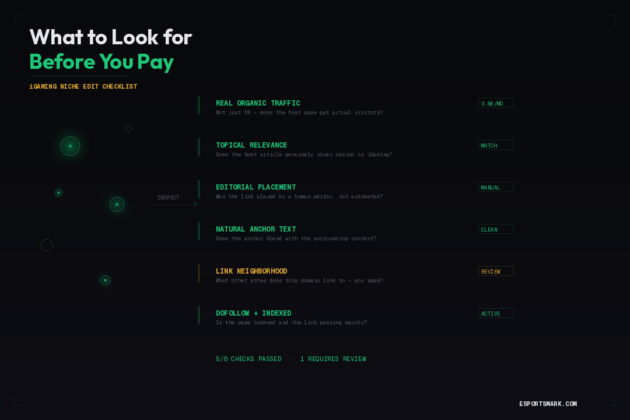
Run every proposed iGaming niche edit placement through these six checks before approving or paying. A placement that passes five out of six is not a placement that passes.
1. Verify real organic traffic on the host page — not just the domain
This is the single most important check and the one most buyers skip. Open the host domain in Ahrefs or Semrush and check organic traffic at the page level, not just the domain level. A domain can have 40,000 monthly visitors while the specific article where your link will sit gets 12. That placement passes zero referral value and minimal authority signal regardless of what the domain metrics show.
Minimum floor: the host page should receive at least 300–500 monthly organic visitors. Prefer pages exceeding 1,000. If the provider will not show you the specific page before purchase, the placement is not worth buying.
The Indie Hackers test found that 12 of 50 purchased niche edits were on pages with zero organic traffic despite the domains showing acceptable DR metrics. Traffic on the host page — not DR on the domain — is the predictor of ranking impact.
2. Check that the host page is actually indexed
Before any money changes hands, confirm the specific article is indexed in Google. A simple site:URL check in Google takes 10 seconds. An unindexed page passes no authority — the link is invisible to Google regardless of how strong the host domain looks. This matters especially in iGaming because gambling content on otherwise mainstream sites is frequently deindexed as part of crawl budget management. The domain stays indexed; the specific gambling article does not.
3. Confirm topical relevance between the article and your target page
Read the article the link will sit inside. Does it genuinely cover casino games, sports betting, iGaming operations, or a closely adjacent topic? A link from an article titled ‘Best Online Casinos 2026’ pointing to your casino review page makes editorial sense. A link from an article titled ‘Top Entertainment Sites’ that mentions casinos in one sentence does not — regardless of the domain’s DR.
The relevance signal is what makes a link worth acquiring in a YMYL niche. An irrelevant link on a high-DR domain consistently underperforms a relevant link on a mid-DR iGaming site. Relevance is now more important than DR in determining actual ranking impact.
4. Verify the link will be dofollow and permanent
These two confirmations should be in writing before you pay, not something you check after delivery. A nofollowed link passes zero PageRank. A link that disappears after 90 days compounds nothing. In iGaming, some publishers apply nofollow attributes to all casino links as default editorial policy — which makes the placement worthless from an SEO standpoint regardless of how good everything else looks.
Ask directly: is this dofollow? Is this permanent? Get both answers in writing. If the provider responds with vague language like ‘we generally keep links live,’ that is not a guarantee.
5. Audit the host domain’s backlink profile for manipulation signals
Pull the host domain’s backlink profile in Ahrefs and look for these specific patterns before approving:
- A sudden spike in referring domains within the past 6–12 months that does not correspond to any visible brand growth, content push, or news coverage
- A high proportion of linking domains using exact-match commercial anchors pointing to the host site
- A large share of linking domains with low-trust extensions (.xyz, .info, .online, .click)
- An unnatural concentration of gambling-to-total linking domains suggesting the site exists primarily to pass links, not serve a real audience
Any of these patterns indicates the domain has been link-farmed itself — and a link from that domain carries the same risk profile as a PBN placement, even if the surface metrics look acceptable.
6. Review outbound link density on the specific placement page
Count the outgoing links on the article where your link will be placed. A page linking out to 20 other sites distributes its equity across all 20. A page with 3 outbound links concentrates that equity. In the iGaming market, pages sold repeatedly to multiple buyers as niche edit placements often show abnormally high outbound link counts — a tell that the page functions as a link farm regardless of its editorial framing.
No firm number applies universally, but flag any placement page with more than 5–8 outbound links and investigate further before approving.
What Separates a Real iGaming Niche Edit from a Fake One
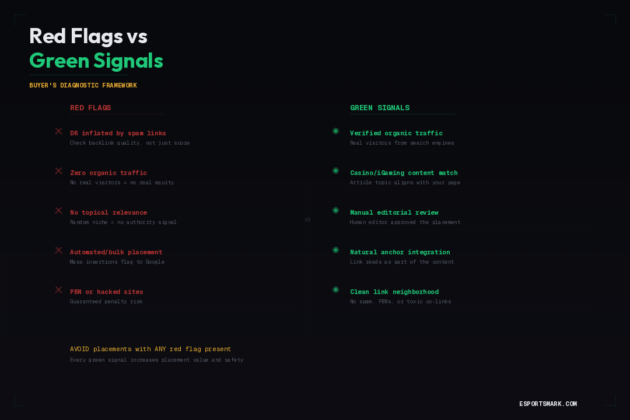
| Signal | Real placement | Red flag |
| Host page traffic | 300–1,000+ monthly organic visitors verified in Ahrefs | High domain DR, near-zero page traffic |
| Indexation | Article confirmed indexed via site:URL check | Domain indexed but article is not |
| Topical relevance | Article topic directly matches your target page | Generic entertainment/lifestyle article, gambling as one mention |
| Link attribute | Dofollow confirmed in writing before payment | Vague or unchecked — discovered nofollowed after delivery |
| Permanence | Permanent placement confirmed in writing | Monthly fee, campaign-term, or no clear policy |
| Host domain profile | Clean referring domains, stable traffic trend | Sudden DR spike, many .xyz/.info linking domains |
| Outbound link density | Fewer than 5–8 outbound links on placement page | 20+ outbound links, page appears to be a link list |
What Legitimate iGaming Niche Edits Actually Cost
The market for iGaming niche edits in 2026 spans an enormous price range: anywhere from $60 to over $1,500 per placement. That range reflects a real quality spectrum — not just provider markup. Knowing what drives price helps you identify when something is too cheap to be real or too expensive relative to what it delivers.
The realistic range for quality iGaming placements: niche edits on genuine gambling-relevant publishers with 500+ monthly organic visitors and clean backlink profiles wholesale between $150 and $400 per placement depending on DR, traffic, and publisher relationship. Placements on high-authority iGaming media (DR 60+, 10,000+ monthly visitors, real editorial teams) command $400–$800 or more.
Why iGaming commands a premium: The “casino tax” is real. Publishers willing to accept gambling content in an editorially credible way are a small subset of the total web. Scarcity drives pricing upward. A niche edit that costs $80 in the iGaming niche is not the same product as a $200 placement — the price difference reflects the publisher quality, not just margin.
Average niche edit costs in 2026 run $200–$600 per placement for quality placements at DR 30–60. In iGaming, add 40–60% above general niche pricing due to the scarcity of compliant, editorially relevant publishers. A placement priced below $100 for a DR 40+ iGaming site is almost certainly a PBN or link farm.
Red Flags That Should End the Conversation
Beyond the six checks above, specific patterns at the pitch or proposal stage should kill the deal immediately:
- The provider cannot show you the live article before payment. You should see the exact URL, the paragraph context, the anchor text placement, and the outbound link count before any money changes hands. A provider who will only reveal the placement URL after payment is not operating transparently.
- They offer high volume of iGaming placements on 24–48 hour turnaround. Real editorial outreach to genuine iGaming publishers takes time. A provider who can deliver 30 casino placements in 48 hours is not working with real publishers. They are pulling from a pre-bought network.
- No replacement or refund policy is stated. Quality iGaming niche edit providers guarantee placements for a minimum period (typically 12 months) and have a defined replacement process if a link drops. Absence of this policy means the provider is not confident in the permanence of what they are selling.
- The domain shows a sudden DR spike with no corresponding brand event. Look at the domain’s DR over the past 12 months in Ahrefs. A domain that went from DR 15 to DR 55 in 90 days without any identifiable PR or content event has purchased its own DR through a link-building scheme — and it will sell that inflated DR to you as a premium placement.
- Every site in their portfolio is in the same niche cluster. A real publisher network has organic diversity. A network built to sell links tends to cluster in obvious ways — all the sites cover casino bonuses, or all of them have the same hosting signatures, or they all link to each other.
How to Structure an iGaming Niche Edit Campaign
Buying iGaming niche edits correctly is not just about individual placement quality. The pattern across a campaign matters as much as any single link.
Anchor text distribution
Anchor text is where most iGaming link building campaigns go wrong. In a YMYL niche that Google monitors closely, an over-optimised anchor profile is one of the clearest manipulation signals. A healthy distribution for casino and sportsbook sites looks roughly like:
- Branded (30–40%) — your casino or site name and its variations
- Partial match / topical (25–35%) — ‘online casino guide,’ ‘sportsbook comparison,’ ‘betting review’
- Naked URL (10–15%) — the URL itself as the anchor
- Generic (10–15%) — ‘click here,’ ‘read more,’ ‘this article’
- Exact match (5–10% maximum) — your primary target keyword, used sparingly
If your provider insists on exact-match commercial anchors for every placement, or cannot advise you on anchor distribution, move on.
Placement cadence
Consistent monthly acquisition of new referring domains compounds in a way that bulk buying does not. Ten iGaming niche edits delivered across a month is more durable than ten delivered in a week, because the acquisition pattern looks natural. Building 40 links in January and zero in February creates a spike pattern that the 2025 spam update specifically targeted.
Link type diversity
A backlink profile made up entirely of niche edits looks as unnatural as one made up entirely of guest posts. Mix link types — niche edits for speed and commercial page authority, guest posts for topical depth and brand credibility, homepage links for sitewide authority. The cluster performs better than any single format alone.
Where We Fit In
At Esports Mark, every casino niche edit we present to a client goes through the full six-point checklist above before it makes it onto a site list. We verify organic traffic at the page level, confirm indexation, read the surrounding content for topical fit, confirm dofollow and permanent placement in writing, and audit the host domain’s backlink profile for manipulation signals. We flag any placement page with high outbound link density.
Nothing gets proposed without passing that process, and no link goes live without your approval on the site URL, the article context, the anchor text, and the target page.
If you want to see exactly what that looks like before committing, we share demo lists specific to your niche, DR range, and traffic minimums. No obligation. Contact us or view our pricing page for iGaming niche edits, casino guest posts, and homepage links.
Request a demo list of verified iGaming niche edit placements real URLs, live DR and traffic metrics, article context. See the quality before you buy.
Frequently Asked Questions
What is the difference between buying iGaming niche edits and buying casino backlinks?
iGaming niche edits are a specific type of casino backlink — a contextual link inserted into an existing, already-indexed article on a gambling-relevant site. ‘Casino backlinks’ is a broader term that includes niche edits, guest posts, homepage links, and other link types. When someone says they want to buy iGaming niche edits specifically, they mean the link insertion format rather than new content creation.
How many iGaming niche edits do I need per month?
There is no universal number. The right volume depends on the authority gap between your site and the pages currently outranking you for your target keywords. A consistent monthly cadence of 3–10 quality placements on genuine iGaming publishers compounds more reliably than irregular bulk orders. Start with a sustainable monthly volume you can maintain for six months rather than a large one-time push.
Can iGaming niche edits hurt my site if they are low quality?
Yes. The 2025 algorithm cycle demonstrated this clearly — sites with PBN-style backlinks that had been sold as niche edits saw their link equity devalued retroactively. In the iGaming niche specifically, where Google scrutinises backlink profiles more closely due to YMYL classification, low-quality placements carry more downside risk than in most other industries. The six-point checklist in this article exists specifically to avoid that outcome.
How long until iGaming niche edits show ranking impact?
Because the host page is already indexed and carries existing authority, niche edits tend to show ranking movement faster than guest posts on freshly published articles. Most clients see initial movement within 4–8 weeks of a quality placement going live, with meaningful ranking gains building over 3–6 months of consistent monthly acquisition.
Should I buy iGaming niche edits or guest posts?
Both, ideally. Niche edits are faster — they access the authority of existing indexed pages and often show ranking impact more quickly. Guest posts are better for topical authority building, brand credibility, and situations where no relevant article exists on the target publisher. A balanced campaign uses both in parallel rather than choosing one exclusively.
What anchors should I use for iGaming niche edits?
A natural anchor distribution heavily weighted toward branded and partial-match anchors, with exact-match commercial keywords making up no more than 5–10% of total placements to a given target page. Over-optimised anchor profiles in iGaming are a specific algorithmic risk given the niche’s YMYL classification and the heightened scrutiny Google applies to gambling backlink patterns.