
iGaming Backlinks: How to Build Authority in a Restricted Niche
Most industries treat the difficulty of link building as a problem to be solved. In iGaming, that difficulty is actually the most important structural advantage available to operators and affiliates who build backlinks correctly.
Because most mainstream publishers refuse gambling content, the pool of legitimate iGaming backlinks is genuinely scarce. That scarcity means every quality placement you secure carries disproportionate weight in Google’s eyes. A site in the fitness niche might need 200 referring domains from a wide field of willing publishers to rank competitively. A casino or sportsbook site that builds 80 referring domains from genuine gambling media and sports publishing may achieve equivalent or greater authority — because each of those 80 is drawn from a pool that your competitors could not easily access.
Understanding that framing changes how you think about iGaming link building: not as a niche that makes SEO harder than everywhere else, but as a niche where the barriers to entry protect the authority you build.
QUICK ANSWER iGaming backlinks are contextual links from gambling-relevant publishers — casino review sites, sports betting publications, iGaming news outlets, and authority domains in adjacent verticals — pointing to your casino, sportsbook, or affiliate pages. In a niche where most publishers refuse gambling content and Google classifies these sites under YMYL, every quality placement you secure carries more ranking signal per link than equivalent placements in most other industries.
Why iGaming Backlinks Matter More Per Link
| YMYL Google classification for gambling sites | 33% Drop in player acquisition cost when domain authority improves | 38% More measurable domain growth from iGaming-specialist link providers | 17% Fewer algorithmic penalties vs. generic link building |
What Makes iGaming Different for Backlink Building
Every experienced iGaming SEO eventually has the same conversation with a client who has worked with a general agency before: the links look fine in a report but the rankings have not moved. The explanation is almost always the same thing. Topical relevance in iGaming is a ranking signal that general link building cannot replicate.
YMYL classification raises the authority threshold
Google’s Your Money or Your Life classification applies to content that could affect a reader’s financial decisions, health, or safety. Online gambling qualifies. YMYL sites are evaluated with stricter quality standards, which means the trust signals Google needs to see before ranking a gambling page are higher than for most commercial niches.
For backlinks specifically, this means Google is not just asking ‘does this site have links?’ — it is asking ‘do these links come from sources that reinforce this site’s credibility in a niche where trust matters?’ A casino site with 200 referring domains from general blogs is evaluated differently from one with 80 referring domains from genuine gambling media. The second profile is likely to rank better in competitive iGaming terms despite having fewer total links.
Publisher scarcity creates a protected advantage
Most mainstream publishing networks have policies that explicitly prohibit gambling content — to protect advertising relationships, editorial positioning, or platform compliance in regulated markets. This creates a supply-side constraint that operates as a barrier to entry for competitors trying to build iGaming backlink profiles.
Specialist iGaming link providers who have built relationships with gambling-willing publishers over years deliver measurably better outcomes than generic vendors. Targeting sector-relevant resources — gambling news publishers, affiliate portals, specialist gaming blogs — yields domain growth 38% more often than generic vendors, with penalty occurrence 17% less frequent throughout observed 2026 campaigns.
Paid advertising restrictions make backlinks more valuable
Google Ads, Meta, TikTok, and most major programmatic networks restrict or prohibit gambling advertising outright or require licensing verification that limits reach significantly. This makes organic search the primary sustainable acquisition channel for most casino and sportsbook brands. When paid traffic is largely unavailable, every ranking position earned through organic SEO is worth proportionally more — which means the link authority that drives those rankings is worth more too.
This is why reducing your acquisition cost by improving domain authority has such a measurable effect in iGaming: each ranking position you climb with organic SEO is not competing with a paid search option — it is replacing one entirely.
The iGaming Backlink Hierarchy: What Moves Rankings
Not all iGaming backlinks carry equivalent value. The 2025 and early 2026 algorithm updates sharpened the relevance weighting in YMYL niches, making the source context of a link a more significant factor than it was even two years ago. Here is the link type hierarchy that reflects current ranking mechanics:
Editorial placements on gambling-specific media
The gold standard. An article published on a genuine iGaming news site, casino affiliate publication, or sports betting media outlet — with a contextual link to your target page — provides the highest combination of topical relevance, editorial trust signal, and authority transfer available in this niche. These are the placements that constitute the core of every effective iGaming link building campaign in 2026.
What defines this category: the publisher covers gambling content as its primary or major editorial focus, has a real editorial team, real organic traffic, and does not accept every casino brand that approaches it. Editorial standards matter — a site that accepts all comers is not operating editorial judgment, which undermines the value of any placement on it.
Niche edits on established gambling pages
Inserting a contextual link into an existing, already-indexed article on a relevant domain gives you access to the authority that page has already accumulated. For commercial pages like casino bonus landing pages, sportsbook review pages, and comparison guides, niche edits are often the most practical mechanism for building authority directly because guest posts on those commercial page types are rare.
Niche edits work fastest when the host page is already ranking for related terms. A well-established article on ‘best online casinos’ that has been accumulating links for three years passes authority to your linked page from day one.
Sports and entertainment media placements
Sports betting and casino gaming have genuine editorial overlap with mainstream sports and entertainment publishing. A sports media site covering major leagues, tournaments, and betting odds has topical adjacency to sportsbook and casino content that a general tech blog does not. Links from sports publications carry more relevance signal for sportsbook and casino pages than their DR alone would suggest, because the topical context reinforces the gambling connection.
Finance and fintech adjacent placements
Payment processing, personal finance, and financial technology have documented overlap with the iGaming space. Casino and sportsbook brands deal with deposits, withdrawals, payment methods, and financial compliance — topics that finance publishers cover naturally. A link from a finance publication in an article about payment methods or responsible gambling finance carries genuine topical relevance for a casino operator, even though the publisher is not gambling-specific.
Homepage links on established gambling niche sites
A permanent, followed homepage or sitewide placement on an established gambling site passes authority across your entire domain rather than just to a single target page. Priced higher than individual article placements, homepage links are used selectively for sitewide authority gains rather than targeting specific page-level rankings.
The link that moves rankings in iGaming is a permanent, dofollow, contextual placement on a gambling-relevant publisher with real organic traffic, a clean backlink profile, and editorial standards that mean your brand had to be approved — not just paid for. Those characteristics, taken together, are what makes each iGaming backlink carry more weight than an equivalent placement in most other niches.
The Three Restrictions That Define iGaming Link Building
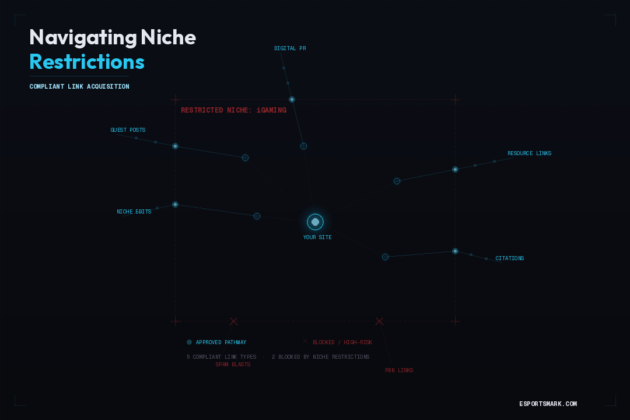
Understanding the structural restrictions in this niche is essential for building realistic expectations and an effective strategy. They are not problems to be worked around — they are the conditions that define what quality looks like.
Restriction 1: Most publishers will not accept gambling content
Editorial teams at mainstream publications routinely decline gambling content for several reasons: concern about audience perception, protection of existing ad relationships, platform-level policies from hosting or network providers, and in some cases direct legal restrictions in the jurisdictions where they operate.
The practical implication is that the outreach conversion rate for iGaming link building is substantially lower than for most other niches. A cold outreach campaign that might expect a 10–15% positive reply rate for SaaS content might see 2–5% for gambling content to the same tier of publisher. This is why relationship-based outreach — working through established publisher contacts rather than cold email — delivers meaningfully better results in this niche and why provider networks built over years have a real advantage over starting from scratch.
Restriction 2: Regulatory compliance limits placement options
Gambling advertising and content regulations vary significantly by jurisdiction. UK Advertising Standards Authority rules, Malta Gaming Authority requirements, US state-level restrictions, and emerging European regulatory frameworks all affect what gambling brands can say, where they can say it, and under what disclosure requirements. A placement that is compliant for a Malta-licensed operator may not be compliant for an operator targeting the UK market.
This means link building in iGaming cannot be separated from compliance awareness. Placements that violate the advertising standards of your target market — even if they look like quality editorial links — create regulatory risk in addition to any SEO considerations.
Restriction 3: Algorithm scrutiny is higher
Google’s spam systems pay specific attention to the iGaming space because the commercial stakes are high and the history of manipulative link building in the niche is well documented. The 2025 algorithm cycle specifically targeted PBN-style placements and link manipulation patterns that had been prevalent in casino link building for years. Sites with profiles built on bulk, low-relevance placements took significant traffic hits.
The consequence is not that iGaming link building is riskier than other niches — it is that the quality threshold for what constitutes a safe placement is higher. A placement that would be benign for a SaaS site can cause algorithmic attention for a casino site with the same profile. The vetting standards applied to iGaming backlinks need to reflect that heightened scrutiny.
Five Proven Approaches to Building iGaming Backlinks
1. Editorial outreach to iGaming publishers
The most reliable long-term approach. Identify genuine gambling-relevant publishers with real organic traffic and editorial standards, pitch content that provides value for their audience, and build placements over time through relationship-based outreach. This takes longer than buying link inventory but produces the most durable placements — because links earned through genuine editorial outreach are what Google’s quality guidelines are designed to reward.
Start with competitor backlink analysis. Export the backlink profiles of your top three ranking competitors in your target market using Ahrefs or Semrush. Identify the domains that have linked to multiple competitors — these are publishers clearly open to gambling content. Those sites are your highest-conversion outreach targets because they have already demonstrated willingness to engage with your niche.
2. Niche edits on existing iGaming content
Rather than creating new content, niche edits insert your link into articles that already exist on relevant sites. For casino and sportsbook operators, this is often the most practical route to building authority on commercial pages because creating guest post content about bonus landing pages or operator reviews is editorially awkward, while inserting a link into an existing review article is natural.
The key vetting points for iGaming niche edits are the same across all quality placements: real organic traffic on the host page (not just domain DR), confirmed indexation, topical relevance between the article topic and your target page, dofollow attribute confirmed before payment, and a clean host domain backlink profile without manipulation signals.
3. Digital PR and data-driven content
Publishing research, data, or commentary that genuine journalists want to cite earns editorial links — the most trusted type in any niche — without requiring direct link requests. In iGaming specifically, data on gambling trends, player behaviour, market size by jurisdiction, or responsible gambling statistics are topics the gambling press covers regularly and will link to authoritative sources for.
A well-executed digital PR campaign in iGaming can generate dozens of editorial links from gambling news sites in a single cycle. These links are hard to earn and impossible to fake, which is why they carry strong authority signals for YMYL content.
4. Strategic partnerships with relevant affiliates
The iGaming affiliate ecosystem is large and well-developed. Casino review sites, sportsbook comparison platforms, and gambling guide publishers all operate as intermediary publishers whose primary function is to link to operators. Building partnerships with established, high-DR affiliates produces genuine editorial placements from sites whose entire content focus is gambling — the strongest possible topical signal.
These relationships take time to build but compound in value: an affiliate that links to your brand across multiple articles over time builds a pattern of contextual endorsement that carries more authority than the same number of links from unrelated sites.
5. Broken link replacement in the iGaming space
Find gambling-related sites with broken outbound links pointing to dead pages, then offer your relevant content as a replacement. In a niche where publishers are cautious about accepting gambling links cold, a broken link replacement is a genuine value exchange — you are solving a problem for the publisher, not asking them to take a risk. Conversion rates from broken link outreach are consistently higher than cold pitches in iGaming because the ask is reciprocal rather than one-sided.
What a Healthy iGaming Backlink Profile Looks Like
The difference between a backlink profile that holds rankings through algorithm updates and one that gets pushed down each cycle is not the total number of links — it is the distribution, diversity, and consistency of acquisition.
| Profile characteristic | Strong iGaming profile | Weak / risky profile |
| Link type mix | Guest posts + niche edits + editorial + homepage | Primarily one type, usually niche edits or PBNs |
| Publisher relevance | 70%+ from gambling, sports, or adjacent niches | Majority from general blogs, entertainment sites |
| Anchor text distribution | Branded dominant, max 10% exact match | Exact match keyword anchors dominate |
| Acquisition cadence | Consistent monthly referring domain growth | Spikes followed by long gaps or bulk orders |
| Host domain traffic | Verified real traffic on host page and domain | High DR but near-zero or bot-driven traffic |
| Link permanence | Permanent placements with written guarantees | Rental links, campaign-term placements, PBNs |
Common iGaming Backlink Mistakes and Their Consequences
The mistakes in iGaming link building tend to cluster around the same decisions, and most of them are driven by the same impulse: trying to move faster than the niche allows.
- Buying DR without buying traffic. Domain Rating is the most visible metric in any link pitch and the most easily manipulated. Expired domains with artificially inflated DR are a well-documented problem in iGaming link building specifically. Paying for DR 60+ placements on sites with no real organic visitors produces no ranking movement and potentially introduces algorithmic risk from a manipulated-profile host domain.
- Over-optimising anchor text for competitive terms. Exact-match anchors pointing to high-competition casino terms are a visible manipulation signal in a niche Google already scrutinises. A profile where 40% of links to a page use the same exact keyword phrase is an algorithmic red flag regardless of the quality of individual placements. Keep exact-match anchors below 10% of total placements to any single target page.
- Using PBNs or expired domain networks. The August 2025 Spam Update retroactively devalued PBN-style links, including many sold as niche edits or ‘curated links’ on gambling-adjacent expired domains. Sites that had been building these profiles for years saw ranking collapses without any new action on their part. In iGaming in 2026, there is no viable version of a PBN strategy.
- Treating link building as a one-time campaign. The top-ranking casino sites for competitive terms have been building referring domains consistently for years. Their competitors are adding new ones every month. A site that buys 50 links in January and then stops is not competing with sites that add 10 quality links every month for 12 months. Consistent cadence is more important than volume.
- Ignoring jurisdiction relevance. A casino targeting UK players does not benefit equally from a link on a Dutch-language gambling site with no UK traffic as from a link on a UK gambling publication. Geo-relevance matters in iGaming because search intent is highly localized and the regulatory environments create distinct markets. Your link building strategy should reflect the markets you are actually targeting.
How Esports Mark Builds iGaming Backlinks
We work exclusively in iGaming, casino, sportsbook, and esports betting verticals. Our publisher network covers genuine gambling-relevant publications vetted for real organic traffic, editorial standards, and clean backlink profiles across the link types that move rankings in this niche: editorial guest posts, niche edits on established gambling pages, and homepage links on established iGaming sites.
Every proposed placement is reviewed against the full quality criteria before it reaches a client site list: host page organic traffic verified at the page level, indexation confirmed, topical relevance evaluated, dofollow confirmed in writing, host domain backlink profile audited for manipulation signals, and outbound link density on the placement page checked. Nothing goes to a client without passing that process, and no link goes live without client approval.
For operators and affiliates evaluating providers, we share demo lists of active iGaming publishers — specific site examples with DR, traffic, article context, and link type — before any commitment. See our pricing page for niche edits, guest posts, and homepage placements across casino, sportsbook, and esports betting inventory.
Request a demo list of vetted iGaming publishers before committing. We share real site examples with DR, traffic, and article context so you can evaluate quality independently.
Frequently Asked Questions
What are iGaming backlinks?
iGaming backlinks are contextual links from gambling-relevant publishers pointing to casino, sportsbook, poker, or affiliate pages. Because most mainstream publishers refuse gambling content, iGaming backlinks are acquired from a narrower pool of specialist gambling media, sports publications, finance-adjacent sites, and iGaming affiliates. This scarcity means each quality placement carries disproportionate ranking weight compared to equivalent links in less restricted niches.
Why is link building harder in iGaming than other niches?
Three structural factors make iGaming link building more difficult: YMYL classification means Google evaluates gambling backlinks under stricter quality standards; most mainstream publishers refuse gambling content, restricting the available publisher pool; and paid advertising options are heavily restricted, making organic rankings more commercially valuable and therefore more competitive to build. The difficulty is real — but it also means the backlinks you do build are harder for competitors to replicate.
What types of backlinks work best for casino sites in 2026?
Editorial placements on genuine gambling media deliver the strongest combination of topical relevance and trust signal. Niche edits on established gambling pages are the most practical route to building authority on commercial pages. Sports and finance-adjacent placements carry real relevance for sportsbook and casino content. Homepage links on established gambling sites provide sitewide authority. PBN-style and bulk directory links have been algorithmically targeted and should be avoided entirely.
How many iGaming backlinks do I need to rank?
There is no universal number. The most useful benchmark is the referring domain count of the pages currently outranking you for your target keyword — that is your first milestone, not a fixed number. The closest comparable industry in published data (Finance and Insurance) requires a median of over 3,000 referring domains for page-one visibility. Competitive national casino terms operate at that range. For our full breakdown of backlink volume benchmarks, see our guide on how many backlinks a casino site needs.
How long does iGaming link building take to show results?
Initial ranking movement on competitive casino and sportsbook terms typically appears within 6 to 12 weeks of consistent link acquisition. Meaningful page-one movement on head terms in competitive national markets generally takes 6 to 12 months of sustained monthly campaigns. Results depend on starting domain authority, keyword competition, and consistency of acquisition. One-time bursts almost never produce durable results because competitors are building continuously.
Are iGaming backlinks safe after the 2025 algorithm updates?
Editorial placements on genuine gambling-relevant publishers with real organic traffic, clean backlink profiles, and dofollow confirmed attribution are safe and remain the primary ranking mechanism in this niche. What the 2025 updates specifically targeted was PBN-style link manipulation, bulk low-relevance placements, and sites with artificially inflated DR. Avoiding those patterns is what separates a safe iGaming link building campaign from a risky one.