
Gambling Link Building: How to Build Backlinks in a Restricted Market
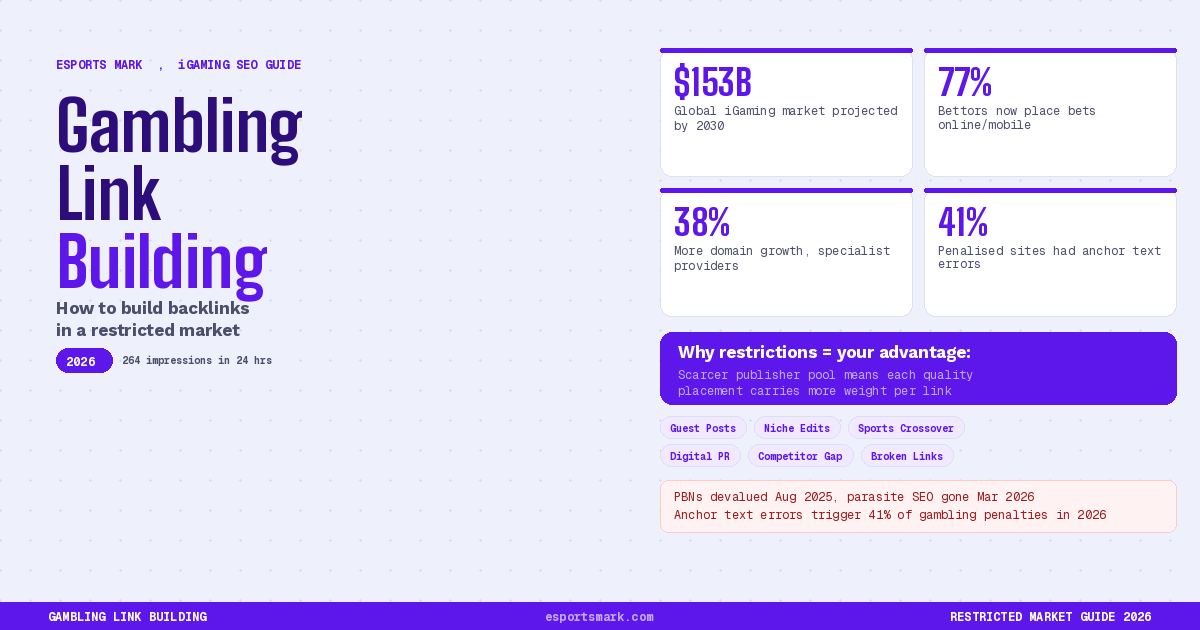
The online gambling market is projected to grow from $78.66 billion in 2024 to $153.57 billion by 2030. Every year that market grows, the competition for organic search visibility grows with it. And every year, the gap between sites that understand how gambling link building works and sites that apply generic SEO thinking to a specialist niche gets wider.
Building backlinks for gambling sites is harder than in almost any other vertical. Publishers are cautious. Advertising regulations restrict where gambling content can appear. Google applies stricter scrutiny to gambling backlink profiles than it does to most commercial niches. And the consequences of getting it wrong, whether through low-quality placements, PBN exposure, or over-optimised anchor text, are proportionally more severe in this space.
This article covers what actually works for gambling link building in 2026, why the market restrictions create a structural advantage for operators who build correctly, and the specific strategies that produce durable ranking improvements rather than short-term movement followed by algorithmic reversal.
QUICK ANSWER Gambling link building is the process of acquiring backlinks from gambling-relevant publishers, sports betting media, and adjacent verticals to improve the organic rankings of casino, sportsbook, poker, and affiliate sites. In a niche where paid advertising is heavily restricted and organic search is the primary acquisition channel, every quality backlink carries disproportionate commercial value compared to equivalent links in less competitive industries.
The Numbers Behind Gambling Link Building in 2026
| $153B Global online gambling market projected by 2030 | 77% of bettors now place bets online or via mobile apps | 41% of penalised sites in 2026 had repeated anchor text errors | 38% more domain growth from specialist vs generic link providers |
Why the Gambling Market Is Restricted for Link Building
Understanding the specific restrictions that apply to gambling link building is not just background context. It is what defines the entire strategy. Each restriction creates a corresponding constraint on where links can be acquired, which publishers will accept gambling content, and what the outreach process looks like compared to other niches.
Publisher content policies
Most mainstream publishing networks have editorial policies that prohibit gambling content. The reasons vary: protecting existing advertiser relationships, compliance with platform-level policies from hosting or network providers, and in some jurisdictions, direct legal restrictions on what content the publisher can carry. The practical result is that the pool of publishers willing to accept gambling links in a credible editorial context is a fraction of the size available in SaaS, e-commerce, or general business niches.
This restriction is also your competitive advantage. Because the publisher pool is genuinely scarce, every quality placement you secure is drawn from inventory your competitors struggle to access equally. A gambling site with 80 referring domains from genuine iGaming media and sports publishers can outrank a competitor with 200 referring domains from general blogs, because the relevance and trust signals from the smaller, higher-quality set of links carry more weight in gambling SERPs specifically.
Regulatory advertising restrictions
Gambling advertising regulation varies significantly by jurisdiction, and those regulations affect link building directly. Several EU countries including Belgium, Italy, and Lithuania have complete bans or severe restrictions on gambling advertising. Germany restricts gambling promotion to nighttime hours. The UK’s Advertising Standards Authority has specific rules around responsible gambling content and endorsements. In the US, advertising rules are set at the state level, which means what is permissible in New Jersey differs from what is permissible in Pennsylvania.
These regulations apply to paid placements on publisher sites in the same way they apply to display advertising. A gambling link building campaign that ignores the regulatory environment of its target markets is creating compliance risk alongside SEO risk. Working with publishers in compliant markets, disclosing paid placements appropriately, and ensuring sponsored content meets responsible gambling requirements is not optional in 2026.
YMYL scrutiny from Google
Google classifies gambling content under YMYL, Your Money or Your Life, alongside medical advice and financial products. YMYL classification means Google’s quality systems evaluate gambling pages with stricter standards than most commercial content. Backlinks to gambling pages are assessed with more sensitivity, which means the quality bar for what constitutes a safe, effective placement is higher than in less scrutinised verticals.
In practice, a link that would be neutral or mildly beneficial for a SaaS client can introduce algorithmic attention for a gambling site with the same profile. The combination of YMYL scrutiny and a niche history of aggressive link manipulation means Google’s spam systems pay specific attention to gambling backlink patterns. This is not a reason to avoid link building. It is a reason to build with editorial quality standards as the baseline rather than the exception.
The Strategies That Work for Gambling Link Building in 2026
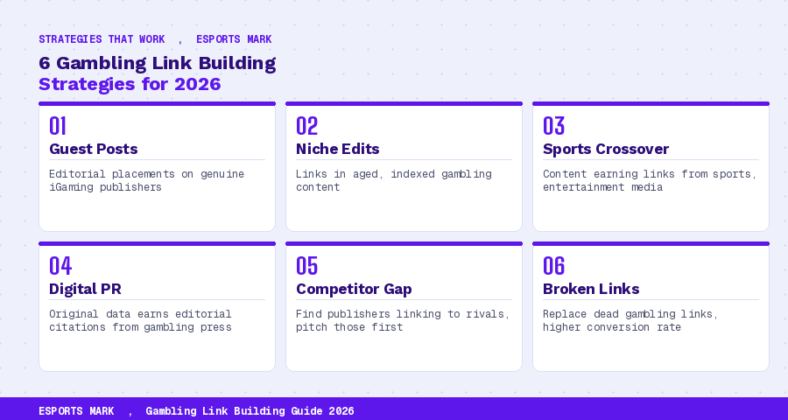
The gambling link building strategies that produced results in 2022 and 2023 are not the same as the ones that produce results now. The 2025 algorithm cycle specifically targeted several tactics that had been standard practice in iGaming SEO for years. What follows reflects the strategies that are currently producing measurable ranking movement for gambling sites across competitive terms.
Editorial guest posts on gambling-relevant publishers
The most reliable long-term approach for gambling link building. An article published on a genuine iGaming news site, casino review platform, or sports betting publication with a contextual link to your target page delivers the strongest combination of topical relevance, editorial trust, and authority transfer available in this niche.
What defines a genuine editorial placement in this context: the publisher covers gambling topics as a primary editorial focus, applies real standards to what it publishes, and does not accept every submission from every gambling brand that approaches it. Publisher selectivity is what makes the link valuable. A site that accepts all comers is functioning as a link farm regardless of how it presents itself in a media kit.
The average outreach success rate for gambling content pitched to mainstream publishers is significantly lower than for other niches because of the content policy restrictions described above. This is why relationship-based access to gambling-willing publishers, built over time through consistent campaign experience, delivers materially better results than cold outreach campaigns in this space.
Niche edits in existing gambling content
Inserting a contextual link into an existing, already-indexed article on a relevant gambling or sports betting site provides immediate access to the authority that page has already built. For commercial pages like casino review pages, bonus landing pages, and sportsbook comparison guides, iGaming niche edits are the most practical mechanism for building authority directly because new guest post content on those commercial page types is editorially difficult to justify.
The host article should have been live for at least 12 to 18 months and should carry its own referring domains before it is considered for a niche edit placement. An older, well-established article on a gambling news site passes authority faster than a freshly published guest post precisely because it has accumulated its own indexing history, its own links, and its own established relationship with the algorithm.
Sports and entertainment crossover content
The most successful gambling link building campaigns in 2026 earn links from publishers who do not primarily cover gambling. Sports, finance, technology, and entertainment outlets provide contextual relevance, genuine authority, and audience overlap when the content earns placement on merit rather than through direct gambling pitches.
An article on a sports news site about how Premier League odds reflect transfer market activity is genuinely interesting to sports fans, and a contextual link to a sportsbook within that content is editorially justified. Casino culture content covering the mathematics of poker or the psychology of live dealer game design can earn links from entertainment and technology publishers that would never accept a traditional casino guest post. These crossover placements diversify a backlink profile beyond the pure gambling publisher ecosystem, which is a naturalness signal that matters for YMYL link evaluation.
Data-driven digital PR
Original research tied to gambling industry trends, player behaviour data, state-by-state legality updates, or responsible gambling statistics gives journalists in both gambling and mainstream media a genuine reason to cite your content. This is the mechanism that produces editorial links from high-authority publications without requiring a direct paid placement relationship.
A well-executed digital PR campaign for a gambling brand can generate dozens of editorial links from iGaming news sites, sports media, and even mainstream business press in a single cycle. These links are impossible to fake, difficult to replicate at scale, and carry some of the strongest authority signals available in the niche because they are editorially chosen rather than commercially arranged.
Competitor backlink gap analysis
Before running outreach to any publisher, export the backlink profiles of the top three ranking pages for your primary target keyword. Identify the domains that have linked to multiple competitors. Those publishers have already demonstrated willingness to engage with gambling content in your target market, which means your outreach conversion rate to them is substantially higher than to cold targets.
This approach produces a prioritised outreach list based on evidence of publisher receptivity rather than assumption. It is the fastest way to identify the specific publishers that constitute your actual obtainable link pool rather than spending outreach budget on rejections from mainstream publishers with gambling content bans.
Broken link replacement in gambling content
Identify gambling-relevant sites with broken outbound links pointing to dead or redirected pages, then offer your relevant content as a replacement. In a niche where publishers are cautious about accepting gambling links cold, a broken link replacement is a genuine value exchange. The publisher has an existing problem with a dead link, and you are solving it. Conversion rates from broken link outreach in gambling are consistently higher than cold pitches because the ask is reciprocal rather than one-sided.
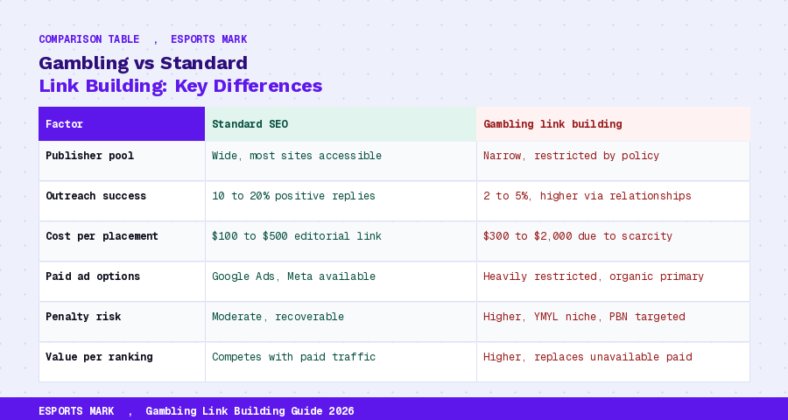
Gambling Link Building vs. Standard Link Building: Key Differences
| Factor | Standard SEO niches | Gambling link building |
| Publisher pool | Wide, most publishers accessible | Narrow, restricted by policy and regulation |
| Outreach success rate | 10 to 20% positive replies typical | 2 to 5% for cold outreach, higher via relationships |
| YMYL evaluation | Standard quality assessment | Stricter scrutiny, higher quality threshold |
| Cost per placement | $100 to $500 per editorial link | $300 to $2,000+ per placement due to scarcity |
| Paid ad alternatives | Google Ads, Meta, paid social available | Heavily restricted, organic search is primary channel |
| Algorithm update risk | Moderate, recoverable from most updates | Higher, YMYL niche, PBN devaluation targeted |
| Value per ranking position | Standard, competes with paid alternatives | Higher, organic often replaces unavailable paid traffic |
What No Longer Works for Gambling Backlinks
The 2025 algorithm cycle specifically targeted several tactics that had been common in gambling link building for years. Being direct about what is no longer viable is more useful than a strategy guide that hedges on dead approaches.
Private Blog Networks
PBNs were once a cornerstone of casino and gambling SEO. The August 2025 Spam Update retroactively devalued PBN-style links across the iGaming space, including many that had been in place for years without previous issues. Sites that had been building PBN links consistently saw ranking collapses without any new action on their part. Google’s AI-powered spam detection in 2026 identifies PBN footprints through hosting patterns, content similarity signals, and cross-linking analysis that makes the classic PBN approach unviable for any site that needs to hold rankings past a 90-day window.
Parasite SEO on mainstream publishers
Publishing thin, keyword-targeted casino content on high-DR mainstream domains to borrow their authority was widely used in gambling link building. In early 2026, Google specifically targeted this practice. Forbes Advisor faced action in this cycle, and several other high-DR publishers lost significant ranking authority for categories where they had been hosting commercially motivated third-party content with minimal editorial standards. The parasite SEO playbook is not viable for gambling content in 2026.
Bulk directory and automated placements
Automated link generation tools producing forum profiles, blog comments, and web 2.0 submissions at scale produce links that register in backlink tools and do nothing in the SERPs. In gambling specifically, where Google already watches backlink patterns more closely than most niches, these placements actively introduce risk by creating the kind of unnatural link velocity and anchor concentration patterns the spam systems are specifically looking for.
KEY STAT 41% of penalised gambling sites in 2026 exhibited repeated anchor text errors as a core factor in their penalty triggers. In a niche where the algorithm is already watching more carefully, anchor text concentration is one of the fastest routes to algorithmic action. Keep exact-match casino keyword anchors below 10% of total links to any single target page.
Anchor Text Strategy for Gambling Link Building
Anchor text is where most gambling link building campaigns accumulate their highest unintentional risk. The iGaming niche already operates under elevated algorithmic scrutiny, and an over-optimised anchor profile compounds that scrutiny directly.
A natural distribution for gambling backlinks looks roughly like this:
- Branded anchors (30 to 40%): your casino or sportsbook name and its variations
- Topical and partial match anchors (25 to 35%): ‘online casino guide‘, ‘sportsbook comparison’, ‘betting review site’
- Naked URL anchors (10 to 15%): the URL itself without anchor text modification
- Generic phrase anchors (10 to 15%): ‘click here’, ‘read more’, ‘visit here’
- Exact match anchors (5 to 10% maximum): your primary target keyword, used sparingly and intentionally
Any provider delivering a batch of gambling backlinks where every placement uses the same exact anchor is creating the concentration pattern that the August 2025 Spam Update specifically targeted. Anchor diversity is a campaign discipline that needs to be tracked across every delivery, not managed retrospectively.
Building a Gambling Link Building Campaign That Holds
The operators and affiliates currently holding competitive rankings for gambling terms did not get there through one-time campaigns. They built consistently over months and years. Here is the structural approach that produces durable results.
- Baseline backlink audit. Before acquiring any new links, understand exactly what your current profile looks like. Export it in Ahrefs or Semrush, identify any toxic or manipulative links from previous campaigns, and disavow them. New quality links build on the existing profile. If that profile has problems, additional links will not fix them.
- Competitor gap analysis. Export the backlink profiles of your top three ranking competitors for your primary keyword. Identify the domains linking to multiple competitors. Those are your highest-conversion outreach targets because they have already demonstrated willingness to engage with gambling content in your market.
- Publisher list curation. Build a list of target publishers vetted for real organic traffic, topical relevance, clean backlink profile, and dofollow capacity. This list is your primary outreach asset and should be maintained and expanded over time as you build publisher relationships.
- Consistent monthly acquisition cadence. Consistent monthly addition of new referring domains compounds more reliably than irregular bulk orders. A natural velocity pattern of 5 to 15 quality placements per month is more durable than 50 links in one month followed by nothing, because acquisition velocity is one of the patterns the spam systems evaluate.
- Anchor text tracking across all deliveries. Maintain a running record of every anchor text used across your campaign to date. Weight new placements to maintain the natural distribution above, and flag any drift toward exact-match concentration before it becomes a visible pattern.
- Semi-annual backlink audit. Check your profile every six months for new toxic links from negative SEO, dropped placements that need replacement, and any anchor concentration that has crept in over time. Brands that apply this discipline recover from algorithm setbacks up to 30% faster than those that audit reactively after a traffic event.
How Esports Mark Builds Gambling Backlinks
We work exclusively in iGaming, casino, sportsbook, and esports betting verticals. Our gambling link building service covers editorial guest posts, niche edits, and homepage placements on genuine gambling-relevant publishers vetted for real organic traffic, clean backlink profiles, and dofollow attribution confirmed before any placement goes live.
Every campaign starts with a full audit of your existing profile, a competitor gap analysis, and a curated publisher list specific to your niche and target markets. You approve every placement before it goes live: the site URL, the article context, the anchor text, and the target page. Nothing moves without your sign-off.
For gambling sites evaluating providers, we share demo lists with live publisher examples, real DR, real organic traffic, and real article context, before any commitment. See our casino marketing services for the full overview, or contact us to discuss your specific targets and what a realistic 2026 campaign looks like for your domain.
Request a free demo list of vetted gambling publishers before committing. Real URLs, live metrics, real article context. See what gambling backlinks actually look like before spending budget.
Frequently Asked Questions
What is gambling link building?
Gambling link building is the process of acquiring backlinks from gambling-relevant publishers, sports betting media, and adjacent verticals to improve a casino or affiliate site’s organic search rankings. Because paid advertising options are heavily restricted in most gambling markets and Google applies YMYL scrutiny to gambling content, backlinks carry disproportionate commercial value compared to equivalent links in less regulated industries.
Why is gambling link building harder than other niches?
Three structural factors make it harder: most mainstream publishers refuse gambling content due to editorial policies and regulatory compliance concerns, which restricts the available publisher pool; Google classifies gambling as YMYL content and evaluates backlink profiles with stricter standards; and paid advertising restrictions make organic search the primary acquisition channel, which raises both the competition and the commercial value of each ranking position.
What link building strategies work for gambling sites in 2026?
Editorial guest posts on genuine gambling-relevant publishers, niche edits in established indexed gambling content, sports and entertainment crossover content that earns editorial placements, data-driven digital PR campaigns, competitor backlink gap analysis to identify receptive publishers, and broken link replacement outreach. These approaches consistently produce ranking movement that holds through algorithm updates. PBNs, parasite SEO, and bulk automated placements do not.
How much does gambling link building cost?
Editorial placements on quality gambling-relevant publishers run $300 to $2,000 per link in 2026, with monthly campaign budgets for competitive terms typically running $40,000 to $50,000 for the top positions. Anything below $300 per link in the gambling niche is almost always a PBN or low-quality placement that will not survive Google’s spam systems or produce meaningful ranking movement.
How long does gambling link building take to show results?
Most gambling link building campaigns show initial ranking movement within 6 to 12 weeks of consistent quality link acquisition. Page-one movement on head terms in competitive national markets generally takes 6 to 12 months of sustained monthly campaigns. Timeline depends on starting domain authority, keyword competition, and consistency of acquisition pace.
Does the regulatory environment affect gambling link building strategy?
Yes, directly. Gambling advertising regulations vary by jurisdiction and affect which publishers you can place content with, what disclosures are required on sponsored placements, and what responsible gambling language must appear in content associated with your brand. UK, EU, and US state-level regulations all create specific constraints. A gambling link building campaign that ignores the regulatory environment of its target markets creates compliance risk alongside SEO risk.