
SEO Backlinks for Online Casino Sites: A Practical Acquisition Guide
Casino player acquisition costs an average of $170 per first-time depositor. That figure creates a compounding problem for operators who rely on paid channels, because every player acquired through advertising carries that cost from the first click. SEO backlinks change that economics. A casino ranking on page one for its target keywords acquires players organically, at a cost per acquisition that falls over time rather than rising with ad auction competition.
The challenge is that SEO backlinks for online casino sites are harder to acquire than in almost any other industry. Publishers are cautious, regulators limit how gambling brands can promote themselves, and Google scrutinises casino backlink profiles more closely than most commercial niches. This guide covers the specific acquisition methods that work in 2026, how to structure a campaign around them, and what the common mistakes are that cost operators months of progress.
QUICK ANSWER SEO backlinks for online casino sites are contextual links from gambling-relevant publishers pointing to casino operator and affiliate pages, acquired to improve organic search rankings in a YMYL niche where paid advertising is heavily restricted. The acquisition process in 2026 combines editorial guest posts on genuine iGaming publishers, niche edits in established gambling content, and digital PR campaigns, with all placements vetted for real organic traffic, topical relevance, and dofollow attribution.
Why Casino SEO Backlinks Matter More Than in Other Niches
| $170 Average casino player acquisition cost per depositor | $239B Online gambling market projected by 2026 | 5,000+ Online casinos and gambling sites registered globally | 292 Editorial backlinks AskGamblers built over 26 months |
The Casino Backlink Acquisition Challenge
Every industry needs backlinks. Casino sites need them more than most, and can get them from fewer places than most. That combination is the defining tension in online casino SEO.
Paid advertising is not a reliable alternative
Google Ads, Meta, TikTok, and most major digital advertising platforms restrict or outright prohibit gambling promotion. This makes organic search the primary durable acquisition channel for most casino operators. When paid traffic is unavailable or prohibitively restricted, every organic ranking position earned through SEO is worth more in absolute commercial terms. A casino that ranks on page one for a high-intent gambling term does not need to outbid competitors in an ad auction every time someone searches.
This is what makes the investment in casino SEO backlinks compound over time in a way that paid acquisition cannot. The cost of maintaining an organic ranking does not increase with market competition. The cost of maintaining a paid position does.
Google classifies casino content as YMYL
Gambling content falls under Google’s Your Money or Your Life classification, alongside medical advice and financial products. YMYL sites face stricter quality evaluation, which means backlinks pointing to casino pages are scrutinised with more scepticism than equivalent links in less sensitive verticals. The implication is specific: the quality bar for what constitutes an effective casino SEO backlink is higher than in most niches, and the consequence of a poor-quality profile is more severe.
Google’s spam systems pay specific attention to the iGaming space because the commercial stakes are high and the history of manipulative link building in the vertical is well documented. A backlink profile that looks acceptable for a SaaS client can trigger algorithmic attention for a casino site with an identical composition.
Publisher restrictions narrow the usable pool
Most mainstream publishing networks have editorial policies that prohibit gambling content. Sites protect existing advertiser relationships, comply with platform hosting policies, and in some jurisdictions face direct legal restrictions on what gambling-adjacent content they can carry. The result is that the pool of publishers genuinely willing to accept casino links in a credible editorial context is a fraction of what is available to other niches.
This restriction is both the challenge and the structural advantage of the niche. Every quality placement you secure from this narrower pool is drawn from inventory your competitors struggle to access equally. An operator with 80 referring domains from genuine iGaming media and sports publishers competes more effectively for YMYL gambling rankings than a competitor with 200 referring domains from general lifestyle blogs, because the relevance and trust signals from the first set of links carry disproportionate weight in gambling SERPs.
The Three Link Types That Drive Casino Rankings
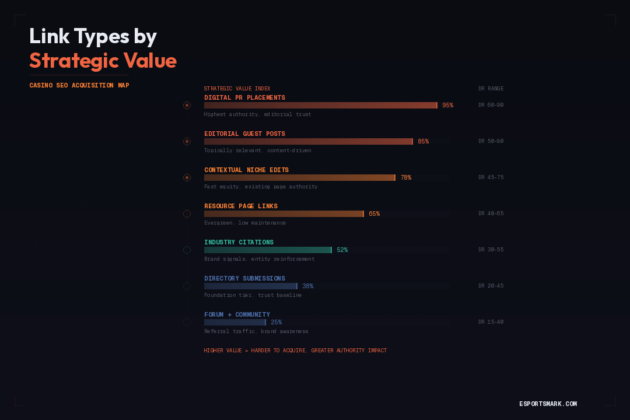
Not all casino SEO backlinks carry equal value. The combination that consistently produces durable ranking movement in 2026 covers three complementary link types, each serving a different function in the authority-building process.
1. Editorial guest posts on genuine iGaming publishers
The most reliable long-term acquisition method. An article published on a genuine casino review site, iGaming news outlet, or sports betting publication, with a contextual link to your target page, delivers the strongest combination of topical relevance, editorial trust signal, and authority transfer available in this niche.
What defines a genuine editorial placement: the publisher covers gambling as a primary editorial focus, applies real standards to what it accepts, and does not publish every submission from every gambling brand that approaches it. The selectivity of the publisher is what makes the link valuable. A site that accepts any placement from any operator is functioning as a link farm regardless of how it presents itself.
The 26-month AskGamblers case study illustrates what this looks like at scale. Over that period, a campaign focused on editorial-first link acquisition delivered 292 editorial backlinks from relevant, authoritative domains. The strategy prioritised high-relevance placements, natural anchor text distribution, and content aligned with regulatory clarity. Instead of short-term ranking spikes, this approach produced steady, durable organic growth that held through algorithm updates. That durability is what the editorial approach buys, and why it remains the foundation of any serious casino SEO backlink campaign.
2. Niche edits in established gambling content
Inserting a contextual link into an existing, already-indexed article on a relevant gambling or betting site gives immediate access to the authority that page has accumulated. For commercial pages like casino bonus landing pages, operator review pages, and comparison guides, niche edits are the most practical mechanism for building authority directly, because creating new guest post content on those commercial page types is editorially difficult to justify.
The performance advantage of niche edits over fresh guest posts comes from the host page’s existing indexing history. An article on a gambling news site that has been live for three years, has accumulated its own referring domains, and has an established relationship with the algorithm passes authority faster than a newly published guest post starting from zero. The equity transfer begins from a position of existing strength rather than from scratch.
3. Digital PR and data-driven citation content
Original research tied to gambling industry statistics, player behaviour data, regulatory developments, or responsible gambling findings gives journalists in both gambling and mainstream media a genuine editorial reason to cite your content. This is the mechanism that produces links from high-authority publishers without requiring a direct paid placement relationship.
A well-executed digital PR campaign for a casino operator can produce editorial links from iGaming news sites, sports media, and mainstream business press in a single cycle. These links are impossible to fake, difficult to replicate at scale, and carry authority signals that position as among the strongest available in the niche because they are chosen by editors rather than commercially arranged.
The combination that consistently outperforms in 2026: editorial guest posts for topical authority and brand presence, casino niche edits for commercial page authority, and digital PR for editorial citations from high-authority publishers. Each type does something the others cannot. Running all three in parallel produces a more natural, more durable profile than concentrating budget on any single format.
Casino SEO Backlink Acquisition Methods at a Glance
| Method | Best use case | Speed | Cost range |
| Editorial guest posts | Brand authority, topical depth | Moderate (4 to 8 weeks) | $300 to $1,500 |
| Casino niche edits | Commercial page authority | Faster (aged page) | $220 to $800 |
| Digital PR campaigns | High-authority editorial citations | Slower (campaign-based) | $500 to $5,000 per campaign |
| Homepage links | Sitewide domain authority | Fast (permanent placement) | $300 to $600 per month |
| Affiliate directory listings | Referral traffic and trust signals | Variable | Free to $500 |
A Practical 90-Day Casino Backlink Acquisition Plan
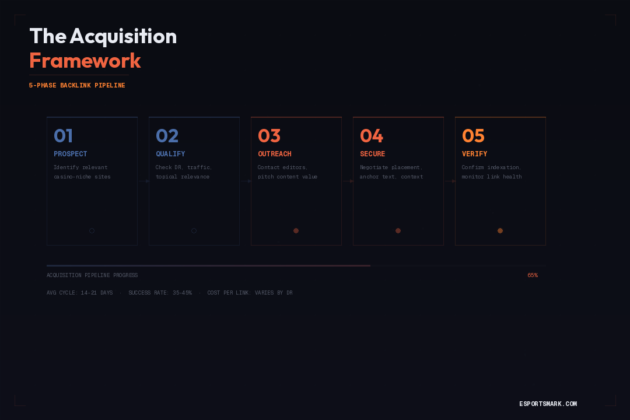
Most casino backlink acquisition campaigns fail because they treat link building as a one-time purchase rather than a structured monthly process. A 90-day framework breaks the work into three phases that each build on the previous.
Month 1, Foundation
Before acquiring any new links, understand your existing backlink profile. Export it in Ahrefs or Semrush, identify any toxic or manipulative links from previous campaigns, and submit a disavow file for confirmed spam. New quality links build on the existing profile, so if that profile has problems, additional acquisition will not fix them.
In parallel, run competitor gap analysis. Export the backlink profiles of your top three ranking competitors for your primary target keywords. Identify the domains linking to multiple competitors. These publishers have already demonstrated willingness to accept gambling content in your target market, which makes them your highest-conversion outreach targets. Building an initial publisher list from this analysis is more efficient than cold outreach to new targets.
Month 2, Outreach and placement
Begin editorial outreach to the publisher list built in month one. Pitch guest post content relevant to each publisher’s audience, focusing on topics that naturally connect to your target pages rather than purely promotional content. For niche edit opportunities, reach out to relevant existing articles on target domains and propose contextual link insertions where your content adds genuine value to what the article covers.
For each proposed placement, run the six-point quality check before approving: real organic traffic on the host page at page level, topical relevance between the article and your target page, dofollow confirmation in writing, permanent placement guarantee, clean host domain backlink profile without manipulation signals, and reasonable outbound link density on the placement page.
Aim for 5 to 15 quality placements across the month. Consistent monthly acquisition compounds more reliably than irregular bulk orders. A natural acquisition velocity pattern is one of the signals Google’s spam systems evaluate, and spikes followed by long gaps create the kind of anomaly that attracts review.
Month 3, Amplification and monitoring
Review the placements from month two. Check that all links are live, dofollow, and indexed. Monitor the referring domain count and any keyword position changes for target pages. Add internal links from your own published articles pointing to the pages that received the most new external links, to help distribute the new equity across your site.
Begin a second outreach cycle targeting a new set of publishers from the competitor analysis and any new relevant domains identified through the previous month’s research. Continue the monthly cadence and document anchor text across all placements to maintain a natural distribution: 30 to 40% branded anchors, 25 to 35% topical partial match, 10 to 15% naked URLs, 10 to 15% generic phrases, and no more than 5 to 10% exact-match keyword anchors pointing to any single target page.
What to Avoid in Casino SEO Backlink Acquisition
The 2025 algorithm cycle specifically targeted several tactics that had been standard practice in casino link building for years. Being direct about what no longer works is more useful than hedging.
- Private Blog Networks. PBNs were once a core casino SEO tactic. The August 2025 Spam Update retroactively devalued PBN-style links, including many that had been in place for years without previous issues. Sites that had been building these profiles saw ranking collapses without any new action on their part. There is no viable version of a PBN strategy for casino sites in 2026.
- Parasite SEO on mainstream publishers. Publishing thin casino content on high-DR general-interest domains to borrow their authority was targeted algorithmically in early 2026. High-profile publishers faced penalties. The tactic is not viable for casino content at scale.
- Over-optimised anchor text. Anchor text concentration is one of the fastest routes to algorithmic attention in a niche that Google already monitors closely. Keep exact-match keyword anchors below 10% of total placements to any target page. Any provider delivering batches where all links use the same exact anchor is creating the pattern that spam systems flag.
- Links from irrelevant niches. A link from an authority gaming blog or a finance site covering payment methods carries relevance for a casino site. A link from a gardening or fashion blog does not, regardless of the domain authority. Casino SEO backlinks need topical adjacency to carry weight in YMYL gambling SERPs.
- Placements with no indexation verification. A link on a page that is not indexed by Google passes no authority. Before considering any placement finalised, confirm the specific host page is indexed. For older content on mixed-topic sites, gambling articles are sometimes deindexed as part of crawl budget management even when the domain itself ranks well.
Providers who can deliver high volumes of casino placements in 24 to 48 hours are not working with real publishers. Genuine editorial outreach to gambling-relevant sites is rate-limited by human relationship-building, which means turnaround takes weeks rather than hours. Speed is a reliable negative signal in casino SEO backlink acquisition.
E-E-A-T and Trust Signals That Support Your Backlinks
Backlinks do not operate in isolation. For casino sites specifically, the E-E-A-T signals on the destination page affect how much value those backlinks can transfer.
Author credentials matter in 2026 in a way they did not in 2022. Every blog article and casino review page on your site should carry an author byline that links to a page demonstrating real gambling industry experience. Google’s quality systems for YMYL content specifically look for human expert authorship as a trust signal, and the absence of it weakens the authority even strong backlinks are trying to build.
Responsible gambling content is a trust signal in its own right. Displaying licensing information clearly, linking to regulatory bodies, and maintaining substantive responsible gambling resources on every page affects how Google’s quality evaluation treats your domain as a citation-worthy source. These are not compliance checkboxes. They are signals that directly affect how backlinks to your pages are weighted.
Methodology transparency on review and comparison content strengthens the credibility of your commercial pages. Describing how you evaluated operators, what criteria you applied, and what testing process you used signals editorial independence, which makes backlinks pointing to those pages carry more weight than backlinks pointing to thin pages with no visible evaluation process.
How Esports Mark Sources Casino SEO Backlinks
Every casino SEO backlink we deliver goes through the full vetting process described in this article before it reaches a client proposal. We check the host page organic traffic in Ahrefs and Semrush at the page level, not just the domain. We read the article and confirm genuine casino or gambling topic coverage. We verify dofollow attribution and permanent placement in writing from the publisher. We audit the host domain’s backlink profile for manipulation signals. We check outbound link density on the placement page.
You see the results of that process before you pay: specific site URLs, live DR and organic traffic metrics, article context, anchor text, and target page, all reviewed and approved by you before any placement goes live.
For casino operators and affiliates evaluating providers, we share demo lists with live publisher examples before any commitment. See our casino marketing services for the full overview, or contact us to discuss your current targets and what a realistic 2026 campaign looks like for your domain and budget.
Request a free demo list of vetted casino publishers before committing. Real URLs, real traffic metrics, real article context. See what genuine casino SEO backlinks look like before spending budget.
Frequently Asked Questions
What are SEO backlinks for online casino sites?
SEO backlinks for online casino sites are contextual links from gambling-relevant publishers pointing to casino operator or affiliate pages, acquired to improve organic search rankings. In 2026, effective casino backlinks come from editorial guest posts on genuine iGaming publishers, niche edits in established gambling content, and digital PR campaigns that earn editorial citations from authority sources in the gambling and adjacent verticals.
Why are SEO backlinks harder to get for casino sites than other niches?
Three structural factors: most mainstream publishers refuse gambling content due to editorial policies and compliance concerns, narrowing the usable publisher pool; Google applies YMYL scrutiny to gambling content, raising the quality threshold for what constitutes an effective backlink; and paid advertising restrictions make organic search the primary acquisition channel, which intensifies competition for the limited pool of casino-relevant backlinks available.
How many SEO backlinks does an online casino site need to rank?
The right benchmark is competitor-specific rather than universal. The closest comparable industry in published data requires a median of over 3,000 referring domains for page-one visibility on competitive terms. The most useful target for your campaign is the referring domain count of the pages currently outranking you for your primary keywords. For a full breakdown of volume benchmarks, see our guide on how many backlinks a casino site needs.
What is the difference between a casino guest post and a niche edit?
A guest post creates a new article on a publisher’s site with a link to your target page. A niche edit inserts a contextual link into an existing, already-indexed article on a relevant site. Niche edits typically show ranking movement faster than guest posts because the host page already has indexing history and accumulated authority. Guest posts are better for topical authority building and brand credibility. Most effective casino SEO backlink campaigns use both.
How long does it take for casino SEO backlinks to show results?
Initial ranking movement on competitive casino terms typically appears within 6 to 12 weeks of consistent quality link acquisition. Page-one movement on head terms in competitive national markets generally takes 6 to 12 months of sustained monthly campaigns. Niche edits in established content tend to show movement faster than fresh guest posts. One-time bulk purchases rarely produce durable results because competitors are building continuously.
How much do SEO backlinks for casino sites cost?
Editorial placements on quality gambling-relevant publishers range from approximately $220 to $1,500 per link in 2026, depending on the publisher’s Domain Rating, organic traffic, and link type. Niche edits typically run $220 to $800. Guest posts on established iGaming media run $300 to $1,500 or more. Monthly campaign budgets for competitive national casino terms typically range from $5,000 to $50,000 depending on the level of competition and starting domain authority.