
Banner Ads vs Backlinks: Which Drives More SEO Value for iGaming?
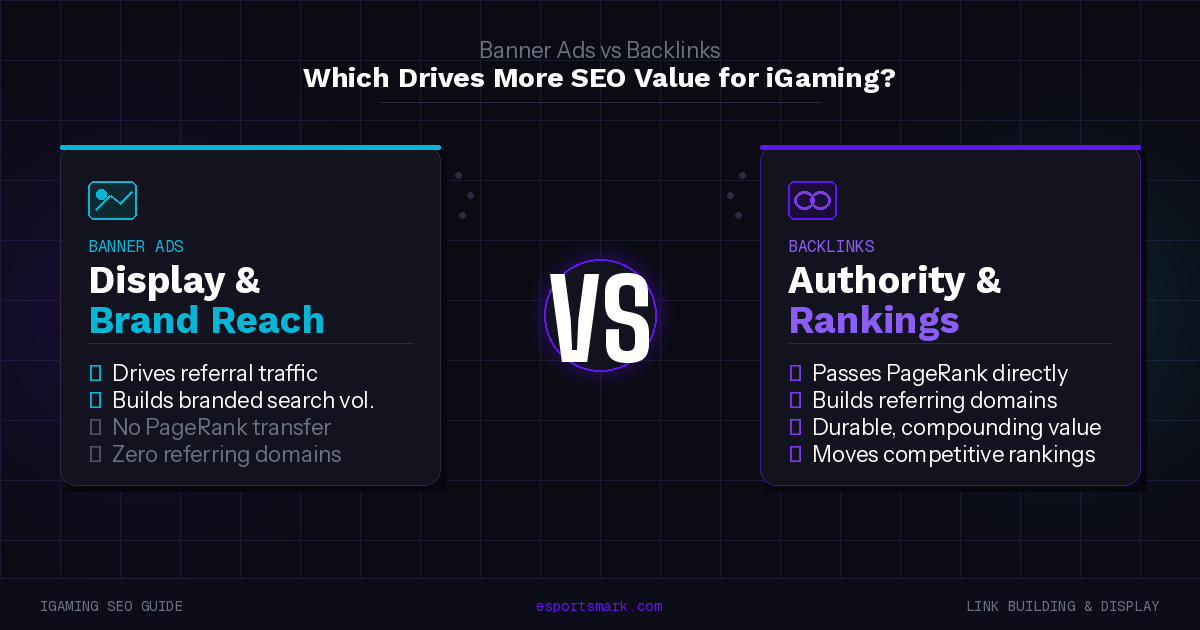
This question comes up a lot, and it deserves a straight answer rather than the usual hedge. Operators and affiliates investing in off-page marketing want to know where their budget does more work — and the answer is not the same for every goal.
The short version: banner ads and backlinks do different things. One builds direct ranking authority; the other builds brand presence that indirectly feeds into how Google values your domain. Understanding what each actually does — not what people assume they do — changes how you allocate budget across both.
Quick Answer: Backlinks pass direct PageRank and authority signals that affect ranking positions. Banner ads carry links that are typically nofollowed or blocked from crawlers, so they pass no direct SEO equity. Banner ads can generate referral traffic and brand signal lift that indirectly benefits SEO, but they cannot replace backlinks as a ranking mechanism. For iGaming operators, the two serve different roles and are not substitutes for each other.
What Banner Ads Actually Do for a Website
Banner ads are display placements — image or rich media ads placed on a publisher’s site that link back to an advertiser’s domain. In the iGaming space, these commonly appear on gambling news sites, sports media, casino affiliate pages, and industry publications.
From an SEO standpoint, the key question is whether the link in a banner ad passes ranking authority to the destination site. The technical answer is: almost always no, and deliberately so.
Google’s link qualification guidelines require that any paid link — including links inside banner ads — carry a nofollow or sponsored attribute. This tells Google’s crawler not to follow the link or pass PageRank through it. Most ad networks go a step further and block crawlers from their redirect chains entirely, using tracking URLs and robots.txt configurations that make the link invisible to Googlebot regardless of its attributes.
This is not a loophole or a grey area. It is how display advertising is supposed to work. Google explicitly separates paid advertising from editorial signals — buying an ad placement is not intended to move rankings, and the technical infrastructure around most ad networks ensures it doesn’t.
So in a direct, ranking-authority sense, a banner ad on a DR 70 gambling site does not pass any of that domain’s authority to your casino. A followed editorial backlink from the same site does.
What Banner Ads Do Indirectly — and Why It’s Not Nothing
The fact that banner ads don’t pass direct link equity doesn’t mean they have zero relevance to your SEO position. The indirect effects are real — they just work through different mechanisms than a backlink.
Referral traffic with real engagement signals. A banner ad on a relevant iGaming publication sends real users to your site. If those users arrive, browse, and interact — spending time on your pages, navigating to bonus offers or game sections — those engagement signals feed into Google’s understanding of your site’s quality and relevance. Sites with strong user satisfaction signals tend to hold rankings better than sites with equivalent backlink profiles but poor on-site behaviour.
Branded search volume. Brand awareness campaigns, including banner placements, increase the number of people who search for your casino by name. Branded search volume is a signal Google uses to calibrate how well-known and legitimate an entity is. A site that generates significant branded search traffic earns a different kind of trust signal than one nobody has heard of.
Entity recognition across the web. Appearing repeatedly on real, well-regarded iGaming publications builds a presence footprint that search engines pick up beyond just link graphs. Brand mentions — even unlinked ones in ad creative text — contribute to entity recognition over time.
None of this is as direct or measurable as a backlink. But treating banner ads as entirely SEO-irrelevant ignores genuine second-order effects that compound over time for brands running consistent display campaigns.
What Backlinks Do That Banner Ads Cannot
A followed editorial backlink from a relevant, high-authority iGaming publisher directly transfers a portion of that page’s authority to your site. That is a concrete, algorithmic ranking signal that no banner placement replicates.
In iGaming specifically, authoritative backlink acquisition remains the dominant ranking factor for competitive iGaming keywords. The sites on page one for terms like “best online casino UK” or “online sports betting” are there because of sustained, intelligent link building accumulated over months or years — not because they ran banner campaigns.
This matters more in iGaming link building than in most niches for two reasons. First, the advertising restrictions in gambling mean organic search is often the primary acquisition channel — paid search on Google, Meta, and most major platforms is heavily restricted or banned outright for gambling brands. Second, the YMYL classification of casino and betting content raises the authority threshold Google expects before it trusts a site enough to rank it competitively. Banner ads don’t move that threshold. Backlinks from credible, relevant publishers do.
Three specific things a backlink does that a banner ad cannot:
Passes PageRank. A followed link from an authoritative gambling publication directly increases the probability that Google ranks your pages for relevant queries. This is the core mechanism of off-page SEO, and it only operates through editorial links — not display placements.
Builds referring domain count. The number of unique domains linking to your site is one of the strongest predictors of page-one ranking positions in competitive iGaming terms. A 2026 study found the closest industry proxy to iGaming — Finance and Insurance — requires a median of over 3,000 referring domains for page-one visibility. Banner ads, regardless of how many sites display them, contribute zero to that count. For a full breakdown, see our guide on how many backlinks a casino site needs to rank.
Creates durable authority. A quality backlink, properly placed and maintained, compounds in value over time as the host page accumulates its own authority. A banner ad stops delivering SEO-adjacent benefits the moment the campaign ends or the budget runs out. A backlink continues working.
| Factor | Banner Ads | Backlinks |
|---|---|---|
| Passes PageRank | ✗ No | ✓ Yes (dofollow) |
| Adds referring domains | ✗ No | ✓ Yes |
| Drives referral traffic | ✓ Yes | ✓ Yes (some) |
| Builds branded search | ✓ Yes | Indirect |
| Authority after campaign ends | ✗ Fades | ✓ Permanent |
| Moves competitive rankings | ✗ Indirectly only | ✓ Directly |
| Compliance with Google policies | ✓ When nofollowed | ✓ When editorial |
Homepage Links: Where the Two Overlap
There is one placement type that sits at the intersection of banner advertising and link building: the homepage link.
In iGaming, homepage links are permanent, sitewide placements on established gambling niche sites — often sold alongside banner or logo placements as part of a sponsorship package. The distinction from standard banner advertising is that a homepage link, when it carries a followed attribute (as opposed to a nofollowed ad unit), passes authority across the linking domain.
A sitewide banner ad on a casino review site with 50,000 monthly visitors passes referral traffic but no PageRank. A followed homepage placement on the same site passes both.
When evaluating any display or banner opportunity on an iGaming publisher, check the link attribute of the placement. A nofollowed banner is an advertising buy. A followed homepage or footer placement is a link building asset. The two look similar in a media kit; they do very different things for your SEO.
The iGaming Paid Advertising Reality
One more layer of context: Google Ads, Meta, TikTok, and most major digital ad platforms restrict or prohibit gambling advertising outright, or require licensing verification and geo-restriction that limits reach significantly.
This means the “banner ads vs backlinks” question in iGaming is not really a choice between two equivalent paid acquisition options. It’s a choice between one paid channel with meaningful SEO-adjacent effects (display advertising on gambling-specific publishers) and one paid channel with direct SEO effects (editorial link acquisition through outreach). The generic paid search and social options available to most industries are largely unavailable — which makes both of these gambling-native options more valuable.
A SaaS company can offset weak organic rankings with Google Ads while it builds authority. A casino operator usually cannot. Every ranking position a casino earns organically is worth more in absolute terms because the paid bypass is not available. That raises the return on investment from real casino link building — and makes banner-only strategies that ignore backlink acquisition a meaningful competitive disadvantage.
How to Think About Budget Allocation
Neither banner ads nor backlinks are wrong investments for an iGaming brand. They’re not competing for the same outcome.
Banner advertising on relevant iGaming publishers makes sense for brand awareness goals, for reaching audiences that don’t yet know your platform exists, and for supporting new market entries where building brand recognition quickly matters.
Link building through editorial placements — niche edits, guest posts, and followed homepage links — is the mechanism for moving organic rankings. It’s slower than a banner campaign, the results compound over months rather than appearing in a week, and it requires careful publisher vetting in a niche where low-quality placements actively damage the sites they link to. But it’s the only tool that directly closes the authority gap between your site and the competitors currently outranking you.
The most effective iGaming operators and affiliates run both in parallel, with separate goals for each. Banner spend is measured on referral traffic, player acquisition, and brand recognition metrics. Link building is measured on referring domain growth, keyword position movement, and long-term organic traffic trajectory. For context on what iGaming SEO looks like in 2026 after the 2025 algorithm updates, that article covers the full picture.
Want to See the Difference in Practice?
We share demo lists of vetted iGaming publishers — with DR, traffic, and link type — before you commit to anything. Tell us your niche, DR floor, and target market.
Request a Demo List →View Pricing
Frequently Asked Questions
Do banner ads help SEO for casino sites?
Not directly. Banner ad links are typically nofollowed or crawled through tracking redirects that block Googlebot, so they don’t pass PageRank or contribute to referring domain count. They can drive referral traffic and brand awareness that has indirect SEO-adjacent effects, but they don’t replace backlinks as a ranking mechanism.
What is the difference between a homepage link and a banner ad in iGaming?
A banner ad typically carries a nofollowed link and is bought as a display placement — it drives traffic but passes no link equity. A homepage link, when sold as a permanent, followed placement on an established gambling site, passes authority and functions as a link building asset. Both may look similar in a publisher’s media kit; the link attribute determines which one is actually helping your SEO.
Why are backlinks more important in iGaming than in other niches?
Two main reasons. iGaming sites are classified as YMYL content, so Google applies a higher authority threshold before ranking them for competitive terms. And because most paid advertising channels — Google Ads, Meta, TikTok — restrict gambling promotion, organic search is the primary acquisition channel for most operators, making each ranking position worth proportionally more.
Can banner ads increase my Google rankings indirectly?
In a limited way, yes. Consistent banner advertising on relevant gambling publishers can increase branded search volume — people searching for your casino by name — which is a signal Google uses to calibrate brand recognition. Display campaigns can also drive traffic with positive engagement signals. But these are second-order effects, not a ranking mechanism, and they don’t accumulate the referring domain authority that determines competitive rankings.
How many backlinks does a casino site actually need to rank?
The right benchmark is competitor-specific rather than universal. A 2026 study found the closest comparable industry to iGaming — Finance and Insurance — requires a median of over 3,000 referring domains for page-one visibility. Competitive national casino terms operate at that range. The most useful target is the referring domain count of the weakest page currently outranking you for your specific keyword. For a deeper breakdown, see our full guide on how many backlinks a casino site needs.
Should a casino brand run banner ads and build backlinks at the same time?
Yes, but with separate goals for each. Banner advertising supports brand awareness, new market entry, and audience reach. Link building drives organic ranking position through authority accumulation. Measuring one by the other’s outcomes — trying to justify banner spend by organic ranking movement, or expecting link building to replace brand awareness — is where budget allocation goes wrong.