
White-Label Link Building for iGaming: What Agencies Need to Know
Most SEO agencies that acquire iGaming clients quickly discover the same problem: delivering link building for casino and sportsbook brands is a completely different job from delivering it for SaaS or e-commerce. The publisher pool is smaller, the compliance requirements are stricter, the cost per placement is higher, and the risk of a bad link doing real damage to a gambling site is disproportionately elevated compared to less-scrutinised niches.
White-label link building — where a specialist provider fulfils link acquisition under your agency’s brand — has become the most common solution to this problem. But the model only works if you pick the right partner and understand exactly what iGaming-specific requirements that partner needs to meet.
This guide covers what white-label link building actually means in the iGaming context, why the niche demands a different approach than general white-label programmes, what it costs, and the questions you need to ask before signing anything.
QUICK ANSWER White-label link building is a B2B fulfilment model where a specialist provider acquires backlinks for your agency’s iGaming clients and delivers unbranded reports you present under your own brand. The provider handles outreach, content, and placement. Your agency keeps the client relationship, the margin, and all the credit. In the iGaming niche, the provider must also have direct relationships with gambling-relevant publishers — something general white-label programmes almost never have.
Why Agencies Need a Specialist White-Label Partner for iGaming
The 2026 State of Link Building survey found that 47% of respondents are agency owners or freelancers serving clients — meaning most link building spend flows through intermediaries rather than direct from brands. The white-label model exists because that flow needs supply. But iGaming is not a niche where a general white-label supplier will do.
Three structural differences separate iGaming link building from everything else:
The publisher pool is fundamentally different
Most mainstream websites refuse gambling content outright to protect their ad revenue and editorial positioning. The publishers that accept casino and sportsbook links in an editorially credible way form a narrow, competitive subset of the web. A white-label provider without pre-existing relationships in sports media, betting news, iGaming industry publications, and gambling-adjacent finance content cannot access this inventory. They will either use low-quality substitutes, PBN-adjacent networks, or decline the work entirely.
When evaluating a white-label partner for iGaming clients, the first question is not about price — it is whether the provider can demonstrate real, live placements on genuine gambling-relevant publishers with verified organic traffic.
YMYL raises the stakes on every placement
Google classifies gambling as Your Money or Your Life content, which means casino and sportsbook pages face stricter quality evaluation than most commercial niches. A bad backlink that would cause minor turbulence for a SaaS client can trigger meaningful algorithmic damage for an iGaming site. White-label providers that work primarily in lower-scrutiny verticals often do not appreciate this risk differential. Their vetting standards, which may be adequate for tech blogs or lifestyle brands, are not adequate for casino and sportsbook domains.
Your white-label partner’s vetting process needs to reflect YMYL standards specifically: real organic traffic on the host page, clean backlink profile on the host domain, topical relevance to the gambling or sports context of the target page, and confirmed dofollow placement.
The 2025 algorithm cycle exposed low-quality casino link profiles
The August 2025 Spam Update retroactively devalued PBN-style links, and the December 2025 core update specifically targeted affiliate sites with manipulative backlink patterns. For agencies that had been using general white-label providers to service iGaming clients, this cycle exposed exactly how much risk sat in those profiles. Agencies with iGaming clients on editorial-first, relevant link profiles saw their clients hold rankings. Agencies that had relied on bulk, low-relevance link packages saw their clients take significant traffic hits.
Choosing the right white-label partner for iGaming is now an existential decision for the client relationship, not just a quality preference.
How the White-Label iGaming Link Building Model Works
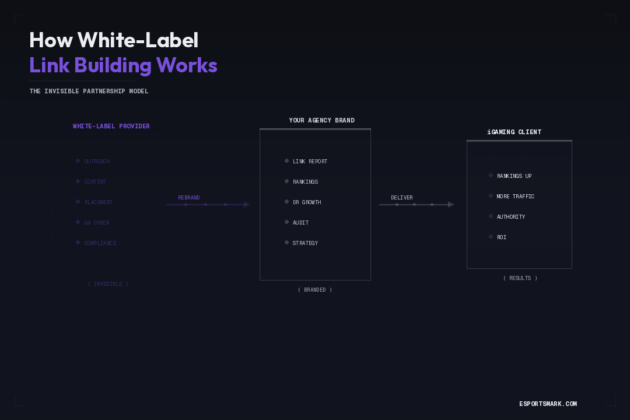
In practice, the white-label model operates as a silent fulfilment partnership. Here is how the workflow typically runs:
- The agency briefs the provider. You supply target URLs, the niche (casino, sportsbook, esports betting, poker), target anchor text guidance, DR floor, monthly volume required, and any site list exclusions (competitor domains, previously used publishers).
- The provider runs outreach. They identify relevant publishers from their existing relationships and network, pitch editorial placements or iGaming niche edit opportunities, and negotiate the placement. In the iGaming niche, this outreach process is significantly slower than in general content niches because the usable publisher pool is smaller and editorial standards are stricter.
- Content is created if required. For guest posts, the provider writes the article and submits it to the publisher. For niche edits, they work with the publisher to insert the link contextually into an existing article. In both cases, the content must meet the editorial standards of gambling-relevant publishers, which typically means experienced writers familiar with the terminology and compliance requirements of the niche.
- Placement is reviewed and approved. You should see the proposed publisher, the article context, the anchor text, and the DR and traffic metrics before the link goes live. Any provider that does not offer client-facing site approval before publication is not operating a transparent programme.
- White-label report is delivered. The report comes unbranded — no mention of the provider’s name, no third-party logos. You add your agency branding and deliver it to the client as part of your monthly reporting. The report should include the live URL, the host domain DR and organic traffic at time of placement, anchor text used, and target URL.
The client never sees the third-party provider at any stage. The invoice, the report, the strategy call, and the quality review all happen between your agency and the client. Your agency is the face of the work — the provider is an invisible operational layer.
What White-Label iGaming Link Building Costs in 2026
Pricing in this space is wider than most agency buyers expect, and the range is meaningful — not just a reflection of quality variation but of genuine structural cost differences between niches.
The broad white-label link building market in 2026 spans $60 to $1,500 per link. For agencies seeking consistent, scalable iGaming placements the realistic wholesale range is $180–$300 per link for mid-tier placements (DR 40–60, 1,000–5,000 monthly organic visitors), with a standard agency markup of 50–100% producing retail pricing of $360–$600 per link to the client.
The iGaming niche commands a premium above general white-label pricing for specific reasons:
- Publisher scarcity premium. Gambling-relevant publishers with real organic traffic and editorial standards are genuinely scarce. That scarcity drives placement costs upward compared to SaaS or e-commerce niches where the usable publisher pool is orders of magnitude larger.
- Compliance and editorial requirements. Gambling content often requires writers with specific niche knowledge, awareness of responsible gambling language requirements, and familiarity with jurisdiction-specific restrictions. That expertise costs more than general content production.
- YMYL risk premium. Providers who genuinely vet iGaming placements to a standard that protects against algorithmic scrutiny invest more time per link than providers applying general vetting criteria. That time is priced in.
| Link Type | Wholesale Range | Agency Retail (2x) | Notes |
| Casino niche edit DR 30–50 | $150–$250 | $300–$500 | Aged page, faster equity |
| Casino guest post DR 40–60 | $250–$450 | $500–$900 | Includes content creation |
| Sports/betting media DR 60+ | $400–$800 | $800–$1,600 | High-auth iGaming publications |
| Homepage link iGaming site | $300–$600/mo | $600–$1,200/mo | Sitewide authority, monthly fee |
Publisher placement fees in the iGaming space have risen 20–40% over the past two years, and the 2026 market shows no sign of this trend reversing. Agencies that lock in wholesale rates with a reliable iGaming provider now are insulating their margin against continued price inflation.
Why General White-Label Programmes Fail iGaming Clients
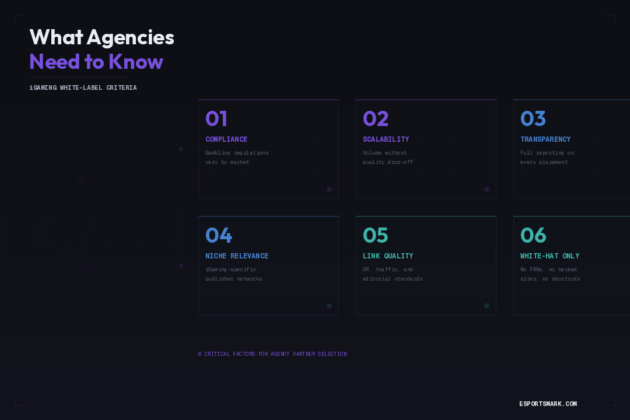
The pitch from general white-label providers is attractive: scale to any niche, consistent delivery, simple pricing. In most niches, that works. In iGaming, it breaks down at the publisher level almost every time.
General white-label providers build their networks around accessible publisher categories — tech blogs, business news, lifestyle media, health and wellness, finance at the general level. These publishers make up the vast majority of the outreach-accessible web. They typically have editorial policies that either explicitly prohibit gambling content or accept it only in vague, low-relevance contexts that carry little authority signal in iGaming SERPs.
A DR 70 general business blog that publishes one casino article in a sidebar of unrelated content is not a meaningful iGaming placement. Google’s quality systems evaluate the topical context of a linking page, not just its domain metrics. An iGaming publisher with half the DR but genuine editorial coverage of gambling topics will consistently outperform it for a casino or sportsbook client.
The failure pattern with general white-label programmes is consistent: strong-looking DR metrics, real traffic on the host domain, but no actual topical relevance to gambling. The links look good in reports and do very little in the SERPs, because the relevance signal is absent.
Questions to Ask a White-Label Provider Before Committing
The vetting conversation with a potential white-label partner for iGaming clients should be specific and uncomfortable for low-quality providers to answer credibly. Here is what to ask:
Can you show me live placements on iGaming-relevant publishers?
Not screenshots, not anonymised URLs — live links on real sites you can visit, audit in Ahrefs, and read the surrounding content. A quality provider in this niche should be able to show you 10 to 20 live examples across casino review sites, sports betting publications, iGaming news outlets, and gambling-adjacent finance content. If the examples are generic tech blogs and lifestyle sites with one gambling article buried in their archives, this provider does not have the network their pitch implies.
What is your vetting process for iGaming publishers?
Listen for: organic traffic verification on the host page (not just domain level), backlink profile check for PBN patterns, topical relevance evaluation specific to the gambling context, dofollow confirmation, and outbound link density on the placement page. A provider that describes their vetting purely in terms of DR and DA numbers is not applying the depth of analysis the iGaming niche requires.
How do you handle anchor text for casino and sportsbook clients?
The right answer is that they document anchor guidelines at the campaign level, monitor the distribution across deliveries, and avoid exact-match concentration. A provider that simply uses whatever anchor you specify without strategic guidance on distribution is passing all the anchor risk to you and your client.
What is your replacement policy if a link drops?
iGaming publishers edit, update, and occasionally remove content. A white-label provider without a clear replacement policy for dropped links is building temporary authority into your client’s profile. Get the replacement policy in writing typically 30 to 90 days from notification — before placing an order.
Do you use PBNs or expired domain networks for any iGaming placements?
This question needs to be asked directly. Many providers use a hybrid of editorial and PBN placements and describe the whole package as editorial. The iGaming niche is specifically vulnerable to PBN exposure because the 2025 algorithm cycle retroactively devalued PBN equity, and casino sites with PBN-heavy profiles took real traffic losses. There is no acceptable level of PBN usage in a white-label iGaming link building programme. Zero is the only answer.
Structuring Your Agency’s White-Label iGaming Offering
Once you have a reliable white-label partner for iGaming, the agency-side structure matters for margin, client expectations, and quality control.
Pricing your retainers
A standard agency markup on white-label iGaming link building is 50–100%. At the lower end of the wholesale range ($180–$250 per link), a 2x markup produces retail pricing of $360–$500 per link consistent with what clients expect for specialist iGaming link acquisition. If you’re adding strategic oversight, reporting, site list curation, and anchor text management as agency services on top of fulfilment, higher margins are justified.
Setting realistic client expectations
iGaming link building takes longer to show ranking impact than clients from other niches are used to. Initial movement on competitive casino terms typically appears within 8–12 weeks of consistent link acquisition. Page-one movement for head terms in competitive national markets ‘best online casino UK,’ ‘sports betting sites’ — typically takes 6 to 12 months of sustained monthly campaigns. Set these timelines at the start of the engagement, not when a client asks why they are not ranking after six weeks.
Maintaining quality control over the provider
White-label does not mean abdication. Your agency’s reputation is on the line with the client, which means you need a review process for every delivery batch before it goes into the client report. Check that the host pages are indexed, verify organic traffic has not fallen since vetting, confirm the link is live and dofollow, and read the surrounding content in context. A batch review takes 30 to 60 minutes per delivery cycle and catches the problems that would otherwise appear in a client’s backlink audit six months later.
How Esports Mark Works as a White-Label Partner
We work with SEO agencies and marketing consultancies that manage iGaming, casino, sportsbook, and esports betting clients. Our link building service operates as a fully rebrandable fulfilment layer — your agency presents the work under your brand, your clients never see our name, and our reports are delivered in a format you can pass straight through or use as a data source for your own client reporting.
Our publisher network covers genuine iGaming and sports media publishers vetted for real organic traffic, clean backlink profiles, dofollow placements, and topical relevance to the gambling or esports content your client needs. We offer Casino niche edits, guest posts, and homepage link placements across casino, sportsbook, esports betting, and iGaming affiliate verticals. Every placement is approved before it goes live.
If you are currently fulfilling iGaming link building in-house and struggling with publisher relationships and volume, or if you are using a general white-label provider and not seeing the ranking movement your clients expect, we can share a demo list of active iGaming publishers before any commitment. Contact us or see our pricing page to discuss agency programme rates.
Agencies managing iGaming clients can request a demo list of active casino and sportsbook publishers with live DR, traffic, and article context. No commitment required. Talk to us to get started.
Frequently Asked Questions
What is white-label link building for iGaming?
White-label link building for iGaming is a B2B fulfilment model where a specialist provider acquires casino and sportsbook backlinks for your agency’s clients and delivers unbranded reports you present under your own brand. Your clients see your agency’s name; the provider stays invisible. The iGaming-specific version requires the provider to have genuine publisher relationships in the gambling niche — something general white-label programmes typically do not have.
Why can’t a general white-label link building provider service iGaming clients?
Most general white-label providers build their publisher networks around accessible categories tech blogs, business media, lifestyle content. These publishers typically prohibit gambling content or accept it only in low-relevance contexts that carry minimal authority signal in iGaming SERPs. A DR 70 general blog publishing one casino article is not a meaningful iGaming placement. Topical relevance to gambling is the primary signal that makes a link move rankings for casino and sportsbook clients.
How much does white-label iGaming link building cost?
Wholesale pricing for iGaming-relevant placements in 2026 ranges from approximately $150 to $800 per link depending on DR, traffic, link type, and whether content creation is included. The standard agency markup is 50–100%, producing retail pricing of $300–$1,600 per link to the client. The iGaming niche commands a premium above general white-label pricing due to publisher scarcity, compliance requirements, and elevated vetting standards.
How do I know if a white-label provider’s iGaming placements are genuine?
Ask for live examples actual URLs on iGaming-relevant publishers you can visit and verify in Ahrefs. Check that the host pages have real organic traffic (not just a high domain DR), that the content genuinely relates to casino or sports betting topics, and that the link is dofollow. Providers who cannot show live examples or whose examples are generic blogs with one gambling article among hundreds of unrelated posts are not working with genuine iGaming publishers.
Can white-label iGaming link building survive Google algorithm updates?
Yes, if the placements are on genuine editorial publishers with real organic traffic and topical relevance. The 2025 algorithm cycle devalued PBN-style links and bulk, low-relevance placements specifically. Casino sites with editorial-first, relevant backlink profiles held their rankings through those updates. The risk comes from providers who mix PBN or link farm placements into their iGaming fulfilment which is why asking directly about PBN usage is a non-negotiable part of the vetting conversation.
How do agencies handle reporting for white-label iGaming link building?
Quality white-label providers deliver reports that include the live URL, host domain DR and organic traffic at time of placement, anchor text used, target URL, and publication date. Agencies rebrand these reports under their own name and either deliver them directly to clients or use the data as a source for their own monthly reporting format. The client never sees any reference to the fulfilment provider.