
AEO for Sportsbooks: How to Rank in AI Answer Engines
When a bettor opens ChatGPT and asks which sportsbook has the best NFL odds, they do not get a ranked list of ten results. They get an answer — with a handful of cited operators and a direct recommendation. Most licensed sportsbooks in the US, UK, and Europe are not in that answer. They are not even close.
A May 2026 study by 5W Research analysed more than 75 consumer-intent queries across ChatGPT, Claude, Perplexity, and Google AI Overviews. The finding is stark: five operators capture more than 92% of AI citation share across the entire US sports betting market. Everyone else — dozens of licensed operators — competes for the remaining 8%.
This is not purely a function of brand size. It is a function of content structure, entity authority, and a discipline that most sportsbooks have not yet started building: Answer Engine Optimisation, or AEO.
QUICK ANSWER AEO for sportsbooks is the practice of structuring content so that AI platforms — ChatGPT, Perplexity, Google AI Overviews, Gemini — cite your operator or affiliate when bettors ask questions about odds, sportsbooks, and markets. Unlike traditional SEO, which targets ranked positions, AEO targets citation inclusion in AI-generated answers. It requires answer-first content structure, consistent entity signals across third-party sources, and schema markup that makes your content machine-readable without guessing.
The Numbers Behind the Shift
| 92% AI citation share held by just 5 operators | 55% of Google searches now show AI Overviews |
| 883M monthly active ChatGPT users | 25% of organic search shifting to AI by 2026 |
What AEO Actually Means for a Sportsbook
Answer Engine Optimisation is the process of optimising content to be retrieved, selected, and cited by AI-powered answer engines when they generate responses to user queries. When someone asks Perplexity which sportsbook offers the best live betting markets, the platform does not show them a ranked list. It generates a synthesised answer and cites its sources. If your sportsbook is not one of those cited sources, you do not exist for that query — regardless of your Google ranking.
This is the core distinction from traditional sportsbook SEO. A page can rank in position three on Google and still never appear in an AI-generated response, because AI engines apply different selection criteria. They prioritise content that is structurally extractable, factually verifiable, and attributed to a recognised entity across multiple credible sources — not just a page with strong keyword density and Casino backlinks.
The standard for AI citation inclusion is higher than simple search ranking. A single AI-generated response can combine information from multiple pages, compare options, summarise tradeoffs, and route traffic only to a handful of sources it deems usable enough to cite. Being indexable and ranking well is necessary but no longer sufficient.
AEO vs. SEO for Sportsbooks: Where They Differ
| Factor | Traditional SEO | AEO |
| Goal | Ranked position in search results | Citation in AI-generated answers |
| Success metric | Clicks, organic traffic, rankings | Citation frequency, share of voice |
| Content structure | Keyword-targeted, long-form | Answer-first, extractable sections |
| Authority signals | Backlinks, domain rating | Entity recognition + editorial media presence |
| Schema | Helpful but optional | FAQPage, Article, Organization — essential |
| Content freshness | Moderate priority | Critical — 83% of AI citations from pages updated within 12 months |
| Search overlap | Google AI Overviews: 76% | ChatGPT: only 8% overlap with Google top 10 |
The two strategies are not mutually exclusive. Ahrefs 2026 data confirms that 38% of AI Overview citations come from pages already in Google’s top 10 organic results. AEO does not replace iGaming link building and technical SEO — it adds a structural and authority layer on top of them.
The AI Citation Gap in Sports Betting
The 5W Research AI Visibility Index analysed ChatGPT, Claude, Perplexity, and Google AI Overviews across queries covering sportsbook selection, betting apps, odds quality, promotions, responsible gaming, state-by-state legality, and sport-specific verticals from NFL to UFC. FanDuel and DraftKings alone held roughly 78% of citation share — matching, and in some sub-categories exceeding, their market share in traditional search.
The insight the 5W report surfaces is not just that large operators dominate. It is why they dominate. AI platforms cite operators with deep editorial media presence — years of coverage in sports media, licensing information consistently referenced across regulatory and news sources, and structured content that answer engines can extract without ambiguity. The operators ranked 6 through 25 are not invisible because they are small. They are invisible because their content and entity footprints are not built for extraction.
Regulatory complexity is a citation accelerator. Operators with clear, verifiable licensing information across multiple state markets get cited disproportionately on state-specific queries because AI engines can confirm jurisdiction eligibility from their content. This is a specific, actionable gap most operators outside the top five have not addressed.
Which AI Platforms Matter Most for Sportsbook AEO
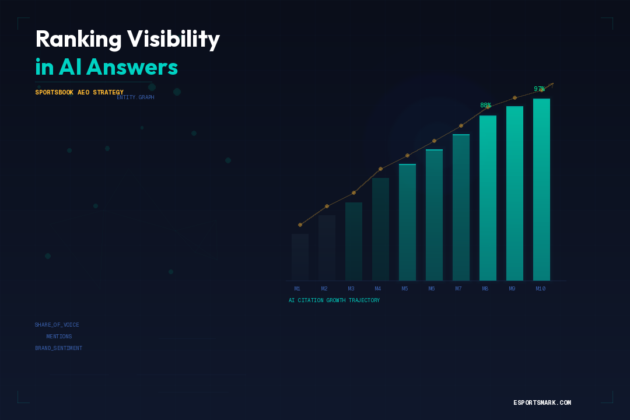
Not all answer engines are equivalent, and optimising for one does not automatically translate to the others. The four platforms with meaningful impact on sportsbook visibility in 2026 are: Google AI Overviews, ChatGPT, Perplexity, and Gemini.
Google AI Overviews appear in approximately 55% of all Google searches and have the strongest overlap with traditional organic rankings — 76% of cited URLs are also in the top 10 organic results. For sportsbooks with strong SEO foundations, Google AI Overviews are the highest-leverage AEO surface to prioritise first.
ChatGPT reaches over 883 million monthly users and has only 8% overlap with Google’s top 10 organic results. Ranking well in Google does not transfer meaningfully to ChatGPT citation — which means a sportsbook can be invisible in ChatGPT answers even with strong organic traffic. ChatGPT citation requires the entity-level authority signals described in the next section.
Perplexity has the strongest overlap with traditional search rankings at 28% and performs real-time web retrieval. Content optimised for both indexation and extractability has a higher probability of Perplexity citation than on ChatGPT or Gemini.
Gemini surfaces in Google’s mobile and assistant ecosystem and weights structured data, local licensing signals, and E-E-A-T signals from YMYL content categories — which includes gambling — more heavily than most general-purpose queries.
Seven AEO Signals That Determine Sportsbook Citation
AirOps’ 2026 State of AI Search Report analysed citation patterns across ChatGPT, Perplexity, Google AI Overview, and Gemini. These are the signals that determine whether your content gets cited or skipped.
- Answer-first content structure. AI engines extract answers at the passage level, not the page level. Each H2 section should open with a direct 40–60 word answer before any context or elaboration. Pages with sequential heading structures (H2 → H3 → H4) show a 2.8x citation lift compared to unstructured equivalents.
- FAQ schema on high-intent pages. FAQPage, HowTo, and Article schema each produce measurable citation lift. On sportsbook pages covering bonus structures, wagering requirements, and state eligibility, FAQPage schema makes answer extraction reliable and is one of the highest-leverage technical changes you can make.
- Entity consistency across the web. Your operator name, licensing jurisdiction, responsible gambling affiliations, and core offering need to be described consistently across your own site, iGaming SEO 2026 publications, licensing body databases, and any third-party reviews that reference you. Inconsistent entity signals make AI engines less confident about attribution.
- Editorial media presence on credible sources. 83% of AI citations for commercial queries come from pages updated within the past 12 months. Guest posts and niche edits on genuine sports and betting media publications build exactly the multi-source entity recognition that AI citation requires.
- State and jurisdiction-specific content. Sportsbooks with detailed, accurate content covering individual state legislation, licensing status, and market-specific terms get cited disproportionately on state-specific queries. Template pages with state names swapped do not produce this signal.
- Responsible gambling and licensing transparency. Gambling falls under Google’s YMYL classification and AI engines apply elevated trust thresholds. Displaying licensing information clearly, linking to regulatory bodies, and including substantive author credentials affects both traditional sportsbook SEO and AI citation eligibility.
- Content freshness maintained quarterly. Pages not refreshed within 12 months are 3x less likely to be cited than recently updated equivalents. Bonus pages, odds comparison content, state landing pages, and responsible gambling resources all need scheduled reviews at minimum every quarter.
The Connection Between AEO and Link Building for Sportsbooks
A misconception in early AEO coverage is that it is purely a content structure problem — fix your headings and schema and you will start getting cited. That is partially true for Google AI Overviews, where organic ranking and AI citation closely overlap.
For ChatGPT and Perplexity, content structure is necessary but not sufficient. These platforms weight entity authority — how widely and consistently your brand is referenced across credible third-party sources — as a primary signal for citation inclusion. An operator mentioned in ten editorial placements on real sports and betting media publications is a more recognisable, trustworthy entity to ChatGPT than one with a perfectly structured website and zero third-party presence.
This is where the referring domain authority that drives traditional sportsbook rankings intersects with AEO. Editorial placements on DR 50+ sports and betting media sites do two things simultaneously: they build the referring domain count that moves organic rankings, and they extend the entity footprint that AI engines use to validate citation sources.
HubSpot’s internal AEO data shows 3x better conversion from leads arriving through AI-referred traffic compared to traditional search visitors — because AI-referred users have already read a synthesised comparison of options before clicking. For sportsbooks, where conversion from awareness to sign-up is the critical funnel step, this quality difference matters significantly.
Where to Start: Practical AEO Priorities for Sportsbooks
Most sportsbooks — even well-resourced ones — are starting from a low AEO Guide. The 5W Research index found that operators outside the top five have citation share so low it is difficult to measure. That makes the starting point straightforward: establish a baseline, then close the most visible structural gaps.
- Audit your current AI visibility. Run your brand name and five key queries across ChatGPT, Perplexity, Google AI Overviews, and Gemini. Document where you appear and where you do not. The gaps are your priorities.
- Retrofit answer-first structure on your highest-traffic pages. Add a 40–60 word direct answer at the opening of each H2 section. This is the single highest-leverage content change with the shortest implementation time.
- Add FAQPage schema to commercial and educational pages. Bonus pages, state landing pages, betting guides, and responsible gambling sections are all candidates. Each FAQ entry is a potential direct citation.
- Audit your entity consistency. Check that your operator name, licensing details, and responsible gambling affiliations are described identically across your site, directory listings, licensing body databases, and third-party reviews.
- Build editorial presence through genuine media placements. Guest posts and niche edits on credible sports and betting publications extend your entity footprint beyond your own domain — which is where ChatGPT and Perplexity citation authority is actually built.
Frequently Asked Questions
What is AEO for sportsbooks?
AEO (Answer Engine Optimisation) for sportsbooks is the practice of structuring content so that AI platforms like ChatGPT, Perplexity, Google AI Overviews, and Gemini cite your sportsbook when bettors ask questions about odds, operators, promotions, or market comparisons. Unlike traditional SEO, AEO targets citation inclusion in AI-generated answers where no ranked list appears.
How is AEO different from SEO for sportsbooks?
Traditional SEO aims for ranked positions in Google search results, measured by clicks and organic traffic. AEO targets visibility inside AI-generated answers, measured by citation frequency and share of voice. A sportsbook can rank on page one of Google and still be completely absent from AI-generated answers, because the two systems use different signals to select sources.
Which AI platforms should sportsbooks prioritise for AEO?
Google AI Overviews, ChatGPT, Perplexity, and Gemini are the four platforms with the most impact. Google AI Overviews appear in roughly 55% of all Google searches. ChatGPT reaches over 883 million monthly users. Perplexity has the strongest overlap with traditional search rankings at 28%, making content optimised for both SEO and AEO most effective on that platform.
Why do only five sportsbook operators dominate AI citation share?
According to the 5W Research US Sports Betting and Gaming AI Visibility Index 2026, five operators capture more than 92% of AI citation share because AI engines favour brands with deep editorial media presence, consistent entity recognition across third-party sources, and content structured for extraction. Smaller operators with thin media footprints are almost entirely absent from AI-generated answers regardless of their search rankings.
How long does AEO take to show results for a sportsbook?
Early signals such as increased AI mentions and citations typically appear within 3 to 4 months of implementing structural content changes, schema additions, and authority-building through editorial placements. Measurable traffic and conversion impact usually shows between months 4 and 6, and compounds from there.
Does traditional link building still matter for sportsbook AEO?
Yes. AEO builds on SEO foundations rather than replacing them. Ahrefs 2026 data confirms 38% of AI Overview citations come from pages already in Google’s top 10 organic results. For sportsbooks, editorial link building from credible sports and betting media publishers remains essential — it builds both the organic authority needed for traditional rankings and the third-party entity recognition that AI engines use to validate citation sources.